



Earbuds With Ear Hooks for High-Impact Box Jumps and Sprint Intervals
High-impact training places severe mechanical demands on personal audio. When landing from a thirty-inch plyometric box jump or accelerating through a maximum-effort sprint interval, the head undergoes rapid vertical deceleration and rotational torque. Standard friction-fit earbuds rely solely on silicone expansion against the smooth skin of the ear canal. Once perspiration coats that contact area, repetitive impacts break surface tension and fling the housings outward.
Solving this issue requires dedicated mechanical anchoring beyond simple canal friction. Athletes generally look at two distinct exterior mounting architectures: wrap-around ear hooks that circle the cartilage root, and open-ear clip cuffs that pinch gently across the helix. Understanding how these designs disperse kinetic force ensures your audio stays locked in place through every explosive rep.
Biomechanical Dynamics of High-Impact Workouts: Why Standard Buds Fall Out
During high-intensity interval training (HIIT), body acceleration shifts across three spatial axes in fractions of a second. A vertical box jump creates a sharp deceleration spike at landing, driving downward momentum directly through the ear cartilage. Sprints introduce high-frequency lateral head shaking and aggressive jaw movements as oxygen intake peaks.
Standard earbuds depend on two physical factors to stay seated: radial friction between silicone tips and the canal wall, and passive support from the tragus and concha bowl. Both mechanisms degrade rapidly under athletic conditions:
- Sweat running down the forehead drains into the concha bowl, coating the canal entrance with water and skin oils that quickly drop silicone friction to near zero.
- Heavy breathing and jaw clenching during explosive lifts flex the temporomandibular joint, which widens and narrows the canal opening with every breath to work friction tips loose.
- The weight of the earbud housing acts like a cantilevered pendulum, levering the tip forward on each foot strike until the seal breaks.
Ear Hooks vs Open-Ear Clip Cuffs: Retention Under Rotational Torque
To overcome canal friction loss, manufacturers build physical bracing systems outside the ear canal. Open-ear earbuds clip on like a cuff or loop over the ear with a hook, using physical retention outside the canal for situational awareness. The two primary methods distribute weight and kinetic energy differently across your ear anatomy.
| Retention Architecture | Primary Contact Point | Shock Absorption Mechanism | Eyewear Compatibility | Best Workout Use Case |
|---|---|---|---|---|
| Flexible Ear-Hook Loop | Behind the pinna / upper helix | Counterweight loop distributes vertical shock | Moderate (can press on sunglass stems) | Heavy road running, trail intervals |
| Open-Ear Clip Cuff | Outer helix and antihelix cartilage | Lateral spring tension clamps across cartilage | High (sits below temple arms) | Box jumps, plyometrics, HIIT calisthenics |
| Standard In-Ear Tip | Internal ear canal entrance | Silicone radial friction against canal walls | High (no outer ear contact) | Low-impact walking, stationary lifting |
Ear-hook models feature a curved silicone or rubber arm that loops over the top of the ear and drops behind the pinna. This loop works by placing a counterweight behind the ear to counterbalance the driver housing in front. For linear movements like marathon running or track sprints, the hook excels because downward shock transfers directly onto the sturdy cartilage root above the ear. However, during rapid multi-directional head turns, the rear counterweight can swing slightly if the flexible arm lacks structural rigidity.
Open-ear clip cuffs adopt a spring-tensioned U-shape clasp. One pod sits outside the canal entrance while a compact battery module grips the outer rim of the ear cartilage. Because the clip grips the firm outer helix rather than draping over the top, it exhibits minimal rotational slippage during sudden head changes, tumbling drills, or burpees.
Product Analysis: EARSOLE Open-Ear Clip-On Wireless Earbuds
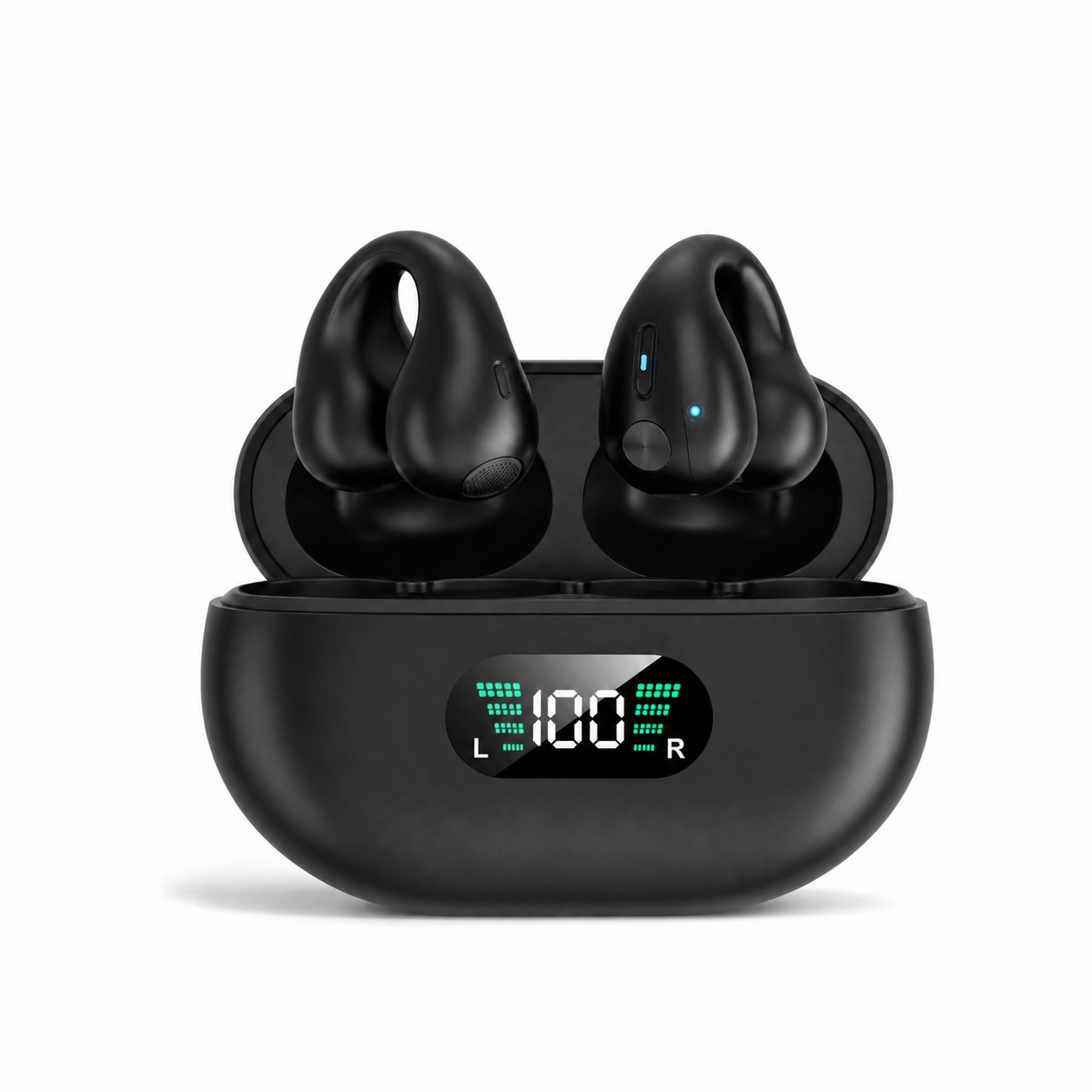
For athletes seeking firm retention without canal pressure or bulky over-ear frames, the EARSOLE Open-Ear Clip-On Earbuds provide an agile solution for explosive gym conditioning. These open-ear clip-on wireless earbuds rest outside the ear canal instead of sealing it shut.
Featuring a discreet black clip-on form factor, the headset mounts cleanly onto the outer helix without invading the acoustic canal. This open-air acoustic architecture leaves environmental sounds audible, allowing runners and gym members to hear approaching traffic, gym timers, and workout partners. The earbuds store inside an integrated LED charging case that displays real-time battery percentages for both pods, eliminating guesswork before long training blocks.
Because the clamping mechanism relies on gentle lateral tension rather than canal suction, sweat buildup along the ear opening does not degrade the grip. Athletes who wear prescription glasses or performance sunglasses will also appreciate that the clip sits along the lower helix, avoiding the crowded space above the ear where traditional thick ear hooks often collide with spectacle arms.
Adjusting Fit and Selecting Tip Sizes for Maximum Deceleration Stability
Achieving complete stability during explosive conditioning requires tuning your gear before the workout begins. Use these steps to optimize retention:
- Clean contact surfaces before warming up. Wiping the back of the ears and cartilage ridge with a dry towel removes skin oils that create an early slip layer.
- Angle the ear hook counterweight flush against the mastoid bone behind your earlobe so the curve rests naturally in the upper cartilage root.
- Position clip cuffs on the outer mid-helix by sliding the clamp onto the thinner upper edge of the ear and gliding it downward until the speaker nozzle aligns with the concha.
- Run a quick stability test with three vertical hops and two rapid head shakes to verify the housing stays stationary relative to your cheekbone.
Sweat Resistance and IPX Ratings for Heavy Gym Sessions
Explosive workouts generate continuous perspiration. Moisture protection ratings determine whether athletic audio can withstand corrosive saltwater exposure over months of hard training:
- IPX4 splash resistance protects against light moisture from any angle, making it adequate for treadmill sessions in air-conditioned gyms.
- IPX5 handles sustained low-pressure water streams and heavy dripping sweat during hot indoor conditioning or humid outdoor runs.
- IPX7 withstands temporary immersion up to one meter for thirty minutes, suited for rainy trail workouts or rinsing under running water.
After completing a high-sweat training block, always wipe down charging contact pins with a microfiber cloth before placing the earbuds into their charging case. Salt crystals left on brass charging terminals can cause galvanic corrosion over time, preventing reliable battery charging.
Frequently Asked Questions
Why are ear hook earbuds better than in-ear buds for box jumps?
Box jumps generate abrupt vertical deceleration when landing on the platform. Standard in-ear buds depend on canal friction, which easily fails when lubricated by sweat and jarred by downward force. Ear hooks loop physically over the cartilage root, anchoring the earbud mechanically so vertical shock cannot dislodge it.
Do ear hooks cause pressure points when worn with glasses?
Thick ear hooks can crowd the narrow groove between the upper ear cartilage and the skull where eyewear arms sit, creating pressure points over time. Athletes wearing thick glasses often prefer open-ear clip cuffs, which mount on the outer cartilage rim well below eyewear stems.
Can sweat damage open-ear sports earbuds during sprint intervals?
Sustained sweat during sprint intervals can seep into unsealed acoustic grilles and charging terminals. Sports earbuds rated IPX4 or higher resist perspiration, but athletes should regularly wipe moisture off the contact points before returning pods to their charging cradle.
