



Choosing walkie talkie earbuds with microphone or wireless walkie talkie earbuds depends on which communication hardware sits at the other end of the connection: a traditional 2-pin handheld UHF/VHF radio, a modern Bluetooth-enabled two-way radio, or a smartphone running a push-to-talk (PTT) team app. According to contributors in r/tacticalcomms, r/woolworths, and r/prepping, workplace two-way radio earpieces are used by mobile floor and dock staff for hands-free communication, many workers replace uncomfortable or shared work earpieces with personal earpieces or multipoint wireless headsets (such as Shokz or Falconclaw PTT setups) that connect to both a radio and a phone, and radio operators note that cellular/Wi-Fi walkie-talkie apps or LTE radios stop working if a local cell tower goes down.
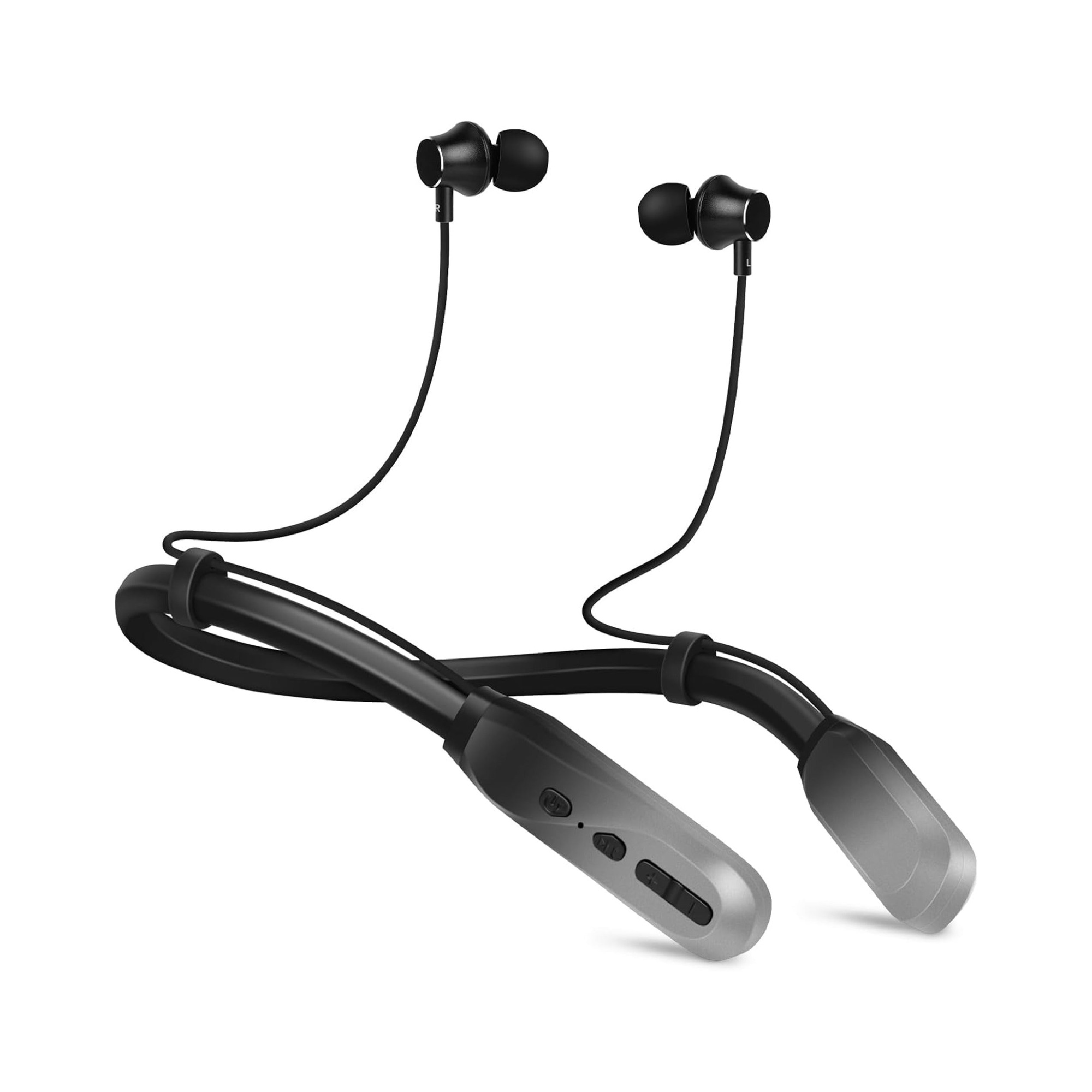
Because online marketplaces use “walkie-talkie headset” as a catch-all label for everything from coiled acoustic tubes to consumer Bluetooth earbuds, buying the wrong style can leave you with a plug that does not fit your radio or wireless earbuds that cannot key your transmitter. Below, we break down why workplace teams use radio earpieces, how Bluetooth Multipoint lets you monitor a Bluetooth-equipped radio and a smartphone at the same time, and where long-battery collar headsets like the EARSOLE Bluetooth Neckband Wireless Earphones fit when your team communicates over smartphone PTT apps.
Why Workplace Teams Use Walkie-Talkie Earpieces—and Why Workers Buy Their Own
On busy retail floors, hotel corridors, security patrols, and warehouse loading docks, open speaker-microphones broadcast every dispatch to customers nearby and get drowned out by pallet jacks and truck engines. That is why employers issue two-way radio earpieces with inline push-to-talk microphones to mobile staff.
In r/woolworths (thread 1wtxj7x, “Team walkie talkies and ear pieces”), retail workers explain who actually needs a walkie-talkie earpiece on shift: one contributor notes, “They’re given to people who move around a lot and might need to be contacted,” while another adds, “Nightfill don’t need them. I use one sometimes when on the dock unloading delivery trucks.” When you are moving between aisles or unloading freight on a dock, an earpiece keeps dispatches audible and private without requiring you to unclip the radio from your belt.
However, the generic earpieces supplied by employers often trigger two immediate complaints—all-day ear fatigue and shared-equipment hygiene. In r/tacticalcomms (thread 1wu5yg3, “Looking for 2 way radio earpiece with ability to multipoint audio from a phone”), a worker describes the exact problem: “My work recently is requiring us to wear earpieces with our radios and the ones they have provided are Bluetooth and also the most uncomfortable hunks of trash, with that I’m looking into just buying a set of wireless earbuds to wear with my radio and if I’m going to spend some money I’d like to be able to hopefully pair my radio (Motorola R5) and phone to listen to music well I work and still get radio calls.”
| Walkie-Talkie Audio Setup | How It Connects to Your Device | Best Shift or Outdoor Use Case | Key Advantage | Hardware Limitation to Watch |
|---|---|---|---|---|
| Wired 2-Pin / Multi-Pin Radio Earpiece | Physical Kenwood K1, Motorola 2-pin, or multi-pin connector with inline PTT button | Traditional UHF/VHF handheld radios without built-in Bluetooth | Zero battery drain on the earpiece; hardware PTT button always works | Tethers your head to your belt; cannot play music from your smartphone |
| Wireless Bluetooth Multipoint Headset + Bluetooth Radio | Pairs wirelessly to a Bluetooth-capable radio (e.g., Motorola R5) and a smartphone simultaneously | Warehouse, dock, or field workers who want phone audio between radio dispatches | No dangling cord; stays connected to both radio and phone at once | Requires a radio with native Bluetooth or a 2-pin Bluetooth dongle + PTT solution |
| Smartphone PTT App + Bluetooth Neckband Earphones | Pairs over standard Bluetooth (A2DP / HFP / AVRCP) to an Android or iOS phone running a PTT app | Store teams, event crews, and drivers using Wi-Fi or cellular walkie-talkie apps | Lightweight fit and multi-day battery life without proprietary radio plugs | Relies on local cell towers or Wi-Fi; cannot plug into a 2-pin handheld radio without an adapter |
Wireless Walkie-Talkie Earbuds & Multipoint: Pairing a Radio and a Phone at the Same Time
If your workplace issues a modern Bluetooth-capable two-way radio—such as the Motorola R5 mentioned in r/tacticalcomms—or if you attach a Bluetooth transmitter dongle with a wireless PTT button to your handheld radio, you do not have to choose between hearing supervisor calls and listening to your phone.
As our guide to what Bluetooth Multipoint is explains, multipoint technology bridges two separate Bluetooth hosts to one headset. SoundGuys defines multipoint as one headset staying connected to at least two source devices, usually with only one streaming media at a time. In SoundGuys’ words (“What is Bluetooth multipoint?”), “Bluetooth multipoint allows headphones to connect to two source devices simultaneously,” and “For example, if you have multipoint headphones connected to both your computer and phone while listening to music on your computer, your headphones will automatically switch to your phone when a call comes in.”
In the r/tacticalcomms thread (1wu5yg3), contributors point workers seeking two way radio earpiece multipoint setups toward two practical paths:
- Dedicated tactical PTT links: One responder suggests checking “Possibly the new Falconclaw PTT?” for bridging tactical PTT controls with headsets.
- Dual-device open-ear or multipoint wireless headsets: Another contributor recommends, “Shokz? They can connect to two devices at once.”
Before buying wireless walkie talkie earbuds for a dual-device workflow, verify two technical details on your radio:
- Standard Bluetooth profile support vs proprietary Bluetooth: Some commercial two-way radios only pair with the manufacturer’s own encrypted Bluetooth earpieces unless standard Hands-Free Profile (HFP) / Headset Profile (HSP) pairing is enabled in the radio’s programming software.
- How Push-to-Talk (PTT) is triggered: Standard consumer Bluetooth earbuds can receive radio audio and send microphone audio when a channel is open, but they do not have a dedicated radio frequency PTT trigger button. You will still press the physical PTT button on the radio body (or a Bluetooth finger/lapel PTT button paired to the radio) when transmitting back to your team.
UHF/VHF Two-Way Radios vs Smartphone Walkie-Talkie Apps & Neckband Earphones
Many teams and families search for walkie talkie earbuds with microphone when they are actually using smartphone walkie-talkie apps (such as Zello, Microsoft Teams Walkie Talkie, or LTE push-to-talk handsets) rather than true UHF/VHF radio waves. Understanding the difference between radio-frequency (RF) walkie-talkies and cellular/Wi-Fi walkie-talkies is essential before you rely on either setup in the field.
In r/prepping (thread 1wdyyd2, ““Global” walkie talkies”), licensed amateur radio operators explain how cellular-based walkie-talkies behave compared to true off-grid radios:
- One ham operator shares: “I’m a ham. My wife isn’t interested in radio, but I bought a pair of UHF Baofeng AT1s that use the mobile phone infrastructure. She does occasionally use these, I see it more as a training/condtioning/experience tool. Whatever you want to call them, they’re a way to get non-radio users to get used to using a walkie-talkie.”
- Another contributor in the same thread warns why cellular walkie-talkies and smartphone PTT apps cannot replace UHF/VHF radios during an outage: “These units sound really good until the backbone of the system breaks. The cell towers. Lose one cell tower in an area, the entire area communications are dead. Someone would have to drive into the next service area to use the smartphone app.”
That distinction gives you a clear rule for choosing your headset:
- For off-grid, emergency, or cell-dead zones: Use true UHF/VHF two-way radios paired with a physical 2-pin earpiece or a dedicated Bluetooth radio adapter that works independently of cell towers.
- For in-building Wi-Fi shifts, retail floors, and daily smartphone voice/PTT dispatch: When your team communicates through smartphones or tablets over Wi-Fi/LTE, a collar-resting Bluetooth neckband avoids the ear-canal fatigue and small battery limits of tiny single-ear radio dongles.
According to the EARSOLE Bluetooth Neckband Wireless Earphones listing, the neckband model uses Bluetooth 5.1, weighs less than 5 grams per earbud, includes L, M, and S soft caps, and lists a 1,000 mAh battery with Type-C charging. Specifically, the EARSOLE listing (cmt2fcmb60060h252qqwhps7z) highlights:
- Multi-shift battery endurance: The 1,000 mAh lithium polymer battery provides up to 200 hours of standby time at 80% volume, charges fully in three hours via the Type-C port, and delivers 10 hours of playback from a 10-minute quick charge.
- Under-5-gram earbuds with L/M/S soft caps: Because the battery and electronics rest on your collar rather than hanging off your outer ear like a bulky clip-on radio earpiece, each earbud weighs less than 5 grams and includes L, M, and S soft caps with clear “L” and “R” markings.
- Built-in microphone and standard Bluetooth profiles: The Bluetooth 5.1 chipset supports HFP 1.7, HSP 1.2, A2DP 1.3, AVRCP 1.6, and SPP 1.2 with a built-in microphone for clear phone calls and voice assistant access across Android phones, iOS devices, laptops, and tablets.
- Important hardware boundary: Consumer Bluetooth earphones like the EARSOLE Bluetooth Neckband Wireless Earphones pair wirelessly with smartphones, tablets, and standard Bluetooth audio hosts—they do not have a wired 2-pin Kenwood or Motorola radio plug and cannot connect to non-Bluetooth handheld two-way radios without a compatible third-party Bluetooth radio adapter.
Frequently Asked Questions
Can wireless Bluetooth earbuds connect to both a two-way radio and a phone?
Yes—if your two-way radio supports standard Bluetooth headset pairing (or uses a Bluetooth radio adapter) and your wireless headset supports Bluetooth Multipoint. SoundGuys defines multipoint as one headset staying connected to at least two source devices, usually with only one streaming media at a time. In r/tacticalcomms (thread 1wu5yg3), workers pairing a Bluetooth-equipped radio (such as a Motorola R5) alongside a personal smartphone use multipoint headsets (such as dual-device Shokz headsets or Falconclaw PTT setups) so incoming radio calls interrupt or overlay phone audio without swapping earpieces.
Do smartphone walkie-talkie apps or 4G LTE radios work when cell towers are down?
No. As radio operators in r/prepping (thread 1wdyyd2) explain regarding cellular-based “global” walkie-talkies (like UHF Baofeng AT1 units that use mobile phone infrastructure) and smartphone PTT apps, those systems depend entirely on cellular towers or Wi-Fi: if you lose the local cell tower in an area, area communications over the smartphone app stop working until you travel into an active service area, whereas traditional UHF/VHF two-way radios communicate directly device-to-device over radio frequencies.
Why do workers prefer neckband or personal earphones for smartphone push-to-talk shifts?
As contributors in r/tacticalcomms (thread 1wu5yg3) and r/woolworths (thread 1wtxj7x) note, mobile floor and dock workers rely on earpieces to stay reachable hands-free, but employer-supplied earpieces are often uncomfortable over long shifts or shared between staff. For teams using smartphone voice or PTT apps on Android or iOS, personal collar headsets like the EARSOLE Bluetooth Neckband Wireless Earphones keep each earbud under 5 grams with L, M, and S soft caps, provide a built-in microphone over Bluetooth 5.1 (HFP 1.7 / HSP 1.2 / A2DP 1.3 / AVRCP 1.6), and pack a 1,000 mAh Type-C battery rated for up to 200 hours of standby time at 80% volume—though you will still need a compatible Bluetooth radio adapter if connecting to a traditional 2-pin handheld radio.
