

Triple-Flange Ear Tips vs Double-Flange Skirts for Deep Second-Bend Isolation
Listeners working in high-noise industrial environments or seeking reference-grade passive sound isolation often abandon standard dome tips in favor of multi-flange silicone sleeves. The graduated skirt architecture creates progressive acoustic boundaries along the ear canal, blocking stubborn low-frequency machinery noise that single silicone domes cannot suppress.
However, inserting silicone skirts past the ear canal’s first anatomical bend requires careful geometric balancing. While triple-flange designs offer extreme sound attenuation by seating near the bony second bend, double-flange skirts provide a forgiving compromise between acoustic isolation and long-term cartilage pressure.
Ear Canal Geometry: Seating Flanges Beyond the First Bend
The human ear canal is not a straight cylinder but an S-shaped corridor divided into an outer cartilaginous zone and an inner osseous framework. The junction between these zones, known as the first bend, naturally resists insertion and presents an uneven cross-section where single silicone domes frequently leak acoustic energy.
Double-flange tips position an initial stabilizing skirt at the aperture while driving a second, smaller cone past the first bend to seal the cartilaginous lumen. Triple-flange sleeves extend this mechanical lever further, placing a third ultra-narrow skirt directly against the second bend to eliminate virtually all ambient air pathways.
| Flange Architecture Profile | Insertion Depth Level | Passive Noise Reduction | Concha Lever Arm Torque | Recommended Session Duration |
|---|---|---|---|---|
| Standard Single-Flange Dome | Shallow (aperture only) | Moderate (15 to 20 dB isolation) | Minimal (flat concha clearance) | All-day wear (6 to 8 hours) |
| Double-Flange Stepped Skirt | Medium (first bend entry) | High (24 to 28 dB isolation) | Low (tolerates moderate lateral movement) | Commuting and office (3 to 5 hours) |
| Triple-Flange Tapered Tree | Deep (approaching second bend) | Extreme (32 to 38 dB isolation) | High (amplifies external housing lever) | High-noise focus (1 to 2 hours) |
| Foam-Filled Dual-Flange Hybrid | Medium (conforming transition) | Superior (28 to 32 dB isolation) | Moderate (damped mechanical vibration) | Travel and air transit (3 to 4 hours) |
Acoustic Damping Mechanics: How Multi-Tier Skirts Halt Sound Leakage
Passive noise reduction in multi-flange tips operates through sequential impedance mismatching. When external sound waves encounter the outer silicone skirt, a major fraction of airborne acoustic energy reflects backward, while residual sound waves enter the trapped air chamber between subsequent flanges.
This multi-cavity barrier acts as an acoustic low-pass filter, dissipating mid-range speech and high-frequency hiss before they reach the eardrum. Furthermore, sealing closer to the second bend reduces ear canal resonance volume, flattening low-frequency boom and enhancing pure instrumental detail without artificial equalization.
Enclosure Leverage and Driver Stem Alignment Across Deep Fits
Achieving a consistent second-bend seal demands that earbud chassis dimensions do not counteract the delicate alignment of the sound bore. Bulky true wireless earbud housings with external touch stems exert outward leverage, pulling deep-seated multi-flange tips off-axis and causing severe cartilage tenderness.
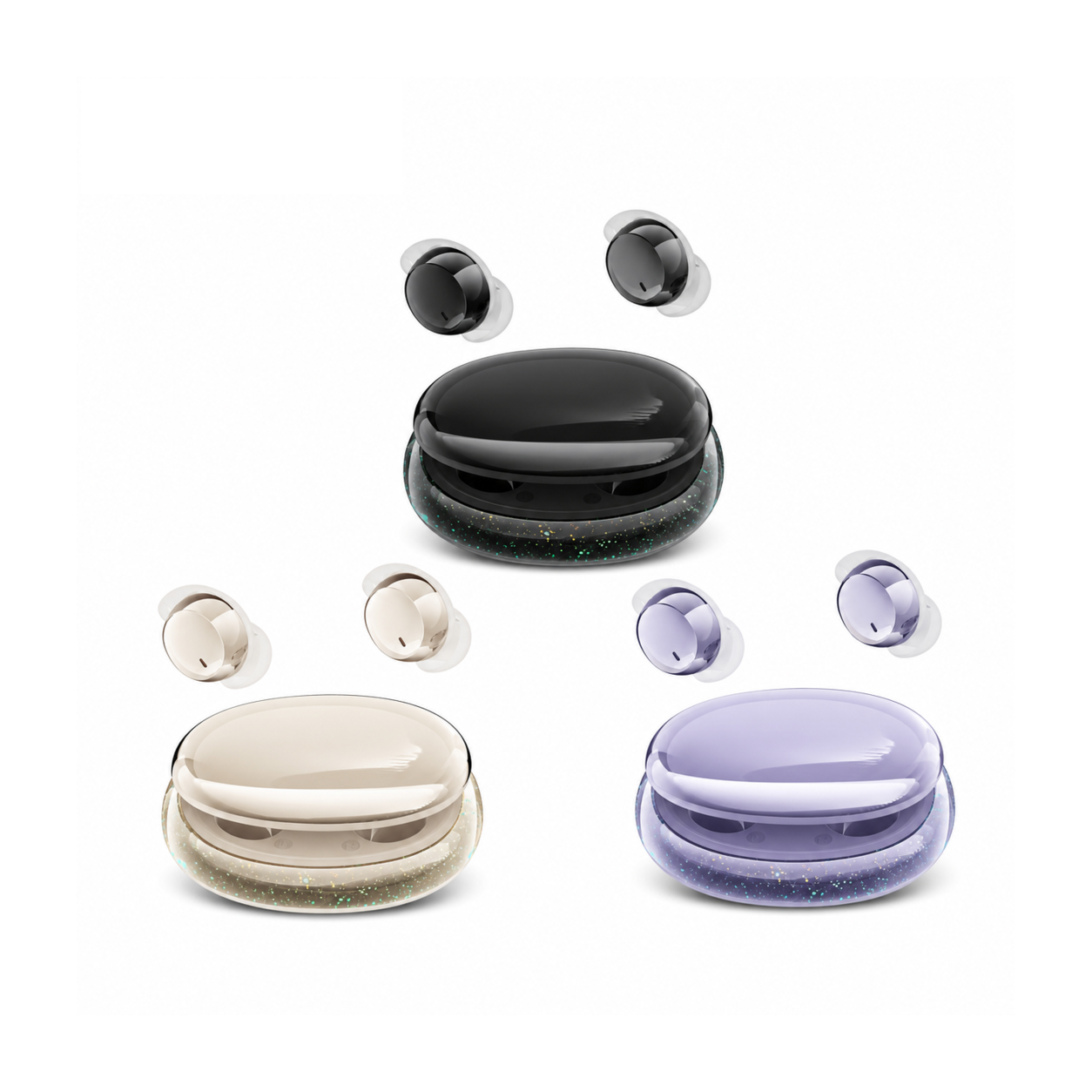
Flat, stemless earbuds for sleeping on your side, with a dynamic sleep-support mode and a starlight glow charging case. See the three colors at EARSOLE.
The EARSOLE Low-Profile Earbuds eliminate outer-ear lever torque by sitting flush against the concha floor. Because the miniature stemless chassis generates zero overhang weight, listeners can pair the earbuds with multi-flange or custom silicone tips without worrying about housing inertia disrupting the acoustic seal during head turns or pillow contact.
Insertion Protocols and Care for Multi-Flange Silicone Sleeves
Deep canal insertion requires methodical hygiene and technique to prevent ear canal abrasion and maintain silicone flexibility:
- Moisture-Free Insertion Technique: Never insert dry silicone aggressively; pull upward and backward on the top of the pinna with your opposite hand to straighten the ear canal before gently seating the sleeve.
- Warm Water Cleaning Only: Wash medical-grade silicone sleeves weekly with mild warm soapy water, thoroughly rinsing away earwax buildup without exposing the core to harsh alcohol solvents.
- Inspect Skirt Elasticity: Replace multi-flange sleeves every four to six months when the thin silicone skirts soften or develop microscopic tears that degrade acoustic isolation.
Frequently Asked Questions
What is the main difference between triple-flange and double-flange ear tips?
Triple-flange tips insert deeper toward the ear canal’s second bend for maximum noise isolation up to 38 dB, whereas double-flange skirts offer comfortable moderate-depth sealing suited for daily listening.
Can triple-flange ear tips hurt my ear canal if worn too long?
Because the narrow third flange presses directly against sensitive deep canal tissue, wearing triple-flange tips for more than two hours without breaks can cause temporary cartilage soreness or pressure fatigue.