Wireless In-Ear Monitors on UHF Beltpacks vs True Wireless Bluetooth Adapters
For live musicians, vocalists, and stage technicians, wireless personal monitoring bridges the divide between physical freedom and acoustic precision. The architecture debate between professional Ultra-High Frequency (UHF) transmitter beltpacks—operating across protected 470–608 MHz broadcast bands—and consumer True Wireless Stereo (TWS) Bluetooth adapters operating at 2.4 GHz centers on three uncompromising metrics: end-to-end latency, radio frequency stability, and acoustic peak limiting.
While Bluetooth audio adapters offer cable-free convenience and direct smartphone pairing, stage monitoring requires imperceptible propagation delay. Understanding how wireless transmission protocols interact with human skull bone conduction, stage RF interference, and ear canal mechanics explains why UHF architectures remain essential for live performance while low-profile Bluetooth solutions serve everyday listening.
RF Propagation, Latency Budgets, and Auditory Phasing
When a vocalist sings, their voice reaches their cochlea through internal skull bone conduction in approximately one millisecond. If their wireless in-ear monitor delivers that same vocal signal with more than five milliseconds of delay, the acoustic wave from the earphones arrives out of phase with the bone-conducted wave, creating severe comb filtering, hollow tonal coloration, and pitch disorientation.
Analogue UHF bodypacks achieve transmission latencies under one millisecond, effectively functioning like a direct copper wire. In stark contrast, standard consumer Bluetooth codecs introduce 40 to 150 milliseconds of latency due to digital packetization and buffer queues, making Bluetooth completely unviable for synchronous stage performance regardless of earbud quality.
| Wireless System Architecture | Transmission Frequency | Round-Trip Latency | RF Congestion Resistance | Primary Practical Domain |
|---|---|---|---|---|
| Analogue UHF Beltpack | 470–608 MHz TV Band | < 1.0 ms (zero audible lag) | High (coordinated channels) | Live touring vocalists & bands |
| Digital UHF Beltpack | 470–608 MHz Encrypted | 2.5 ms to 3.5 ms | Exceptional (error correction) | Arena concerts & broadcast |
| 2.4 GHz Digital Wireless | 2.4 GHz ISM Band | 4.0 ms to 7.0 ms | Moderate (Wi-Fi vulnerability) | Small churches & club venues |
| True Wireless Bluetooth | 2.4 GHz BT 5.3 / LE | 40 ms to 150 ms | Low (smartphone interference) | Casual listening & rehearsal |
Dynamic Range, Headroom, and Peak Sound Limiting
Live sound environments present sudden acoustic transients, such as accidental microphone drops, loud snare hits, or acoustic feedback squeals. Professional UHF beltpack receivers integrate analog brickwall limiters that instantly arrest high-voltage spikes, preventing high sound pressure levels from damaging a performer’s sensitive hearing.
Consumer Bluetooth earbud adapters rely on software volume leveling designed for pre-recorded, normalized music files rather than volatile live microphone inputs. Subjecting consumer Bluetooth adapters to live stage soundboard feeds risks audio clipping, amplifier overload distortion, and dangerous sound bursts directly into the ear canal.
Battery Reliability, Mechanical Ergonomics, and Daily Utility
Professional UHF receivers utilize quick-swap AA battery sleds that allow road crews to replace power cells in ten seconds between songs, guaranteeing uninterrupted multi-hour performances without waiting for charging cases. However, their bulky metal housings, protruding whip antennae, and heavy cables make them completely impractical for daily travel or resting.
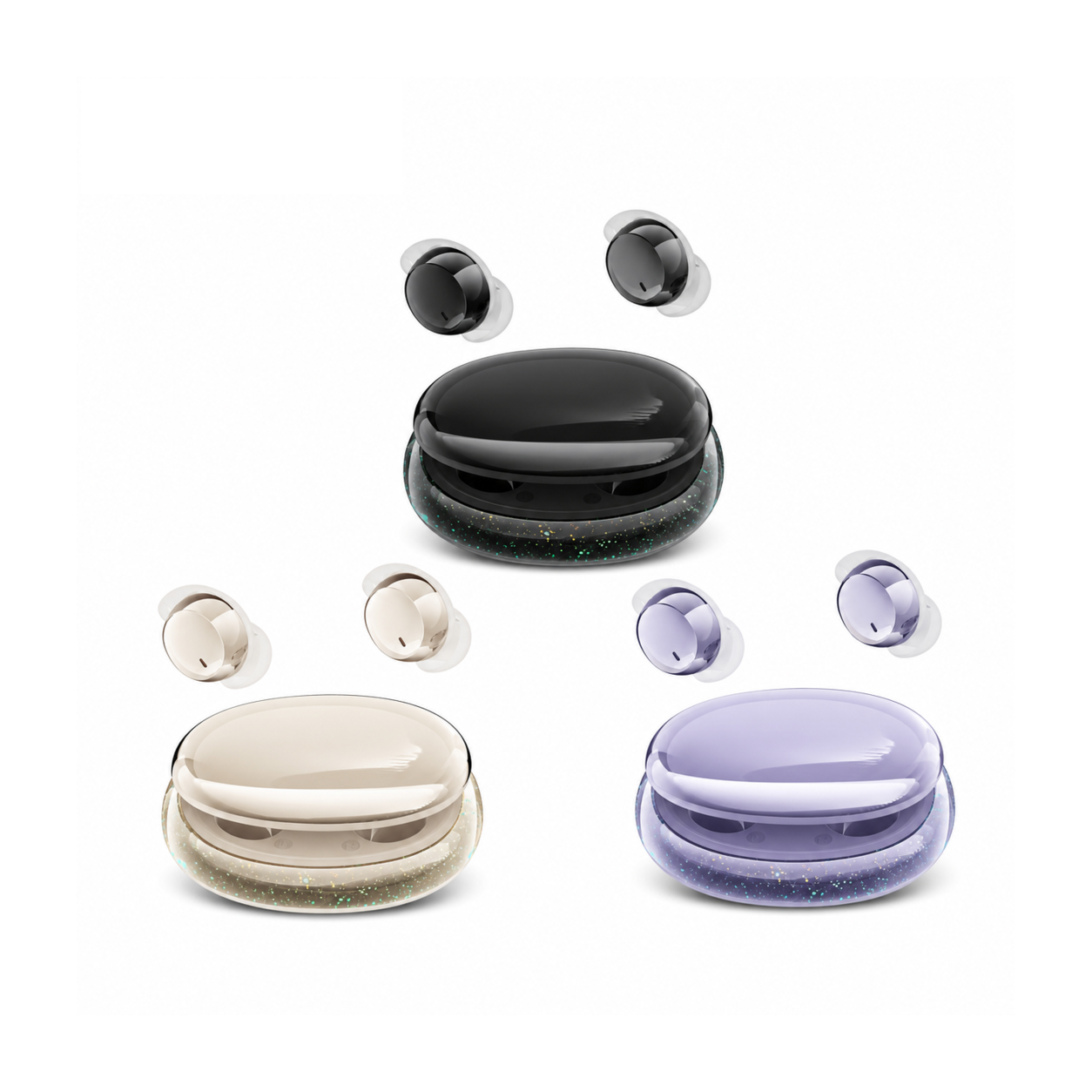
Flat, stemless earbuds for sleeping on your side, with a dynamic sleep-support mode and a starlight glow charging case. See the three colors at EARSOLE.
For relaxing at home or sleeping without physical cord entanglements, listeners transition away from bulky stage packs toward specialized flush earbuds. The EARSOLE Low-Profile Earbuds eliminate external bodypacks, offering featherweight ergonomic silicone bodies that sit entirely inside the concha without snagging pillows or protruding during side sleep.
Strategic Criteria for Wireless Monitoring Systems
Select your wireless monitoring infrastructure by matching transmission hardware to acoustic and mobility requirements:
- Deploy UHF Beltpacks for Live Vocal Timing: For professional touring where sub-3ms latency and coordinated spectrum immunity are imperative, dedicated UHF systems remain irreplaceable.
- Use 2.4 GHz Wireless for Small Rehearsal Spaces: For community bands or small venues free from crowded smartphone Wi-Fi networks, compact 2.4 GHz packs offer solid mid-tier utility.
- Adopt Stemless Bluetooth Earbuds for Off-Stage Recovery: When resting after intense rehearsals, ultra-compact flush Bluetooth earbuds provide comfortable, tangle-free wireless audio.
Frequently Asked Questions
Can you use Bluetooth earbuds as live stage monitors?
Standard Bluetooth codecs produce 40 to 150 milliseconds of latency, creating cognitive delay and phase cancellation that make live vocal and instrument timing impossible.
Why do professional touring musicians use UHF instead of 2.4 GHz?
UHF bands avoid congested 2.4 GHz audience Wi-Fi and smartphone interference, delivering reliable multi-channel transmission with zero dropouts across large concert arenas.