

A volume limit on kids headphones caps how loud the headphones can play; it does not set how long a child can safely listen. The WHO-ITU children's mode is 75 dB for 40 hours a week, and the allowance shrinks fast above that: 85 dB leaves roughly four hours a week and a 94 dB cap about half an hour. A parent controls the time; the box only states the ceiling.
Where 85 dB and 94 dB come from
Both numbers are printed on the cable switch of one of our own kids models, pictured below. The lower one is a workplace figure: NIOSH recommends keeping worker exposure below a level equivalent to 85 dBA for eight hours, as OSHA's noise page restates, along with the rule that makes decibels bite: every 3 dBA increase doubles the noise and halves the recommended exposure time.
The NIDCD draws the general line lower: sounds at or below 70 dBA, even after long exposure, are unlikely to cause hearing loss, while long or repeated exposure at or above 85 dBA can. It lists music through headphones at maximum volume, sporting events and concerts at 94 to 110 dBA, so a 94 dB cap sits at the bottom of that range, three doublings above the workplace figure.
The only figure written for children is in the WHO-ITU safe listening standard: mode 1 for adults is 80 dB for 40 hours per week; mode 2 for children is 75 dB for 40 hours per week. Neither number on the box appears in it.
Before you apply this to your own child
Who this is not for
This is not written for babies or toddlers. A child who cannot tell you a sound is uncomfortable cannot be handed a volume control, and the NIDCD's advice is to protect the ears of children who are too young to protect their own. The answer for an infant is not earbuds or headphones at all, and we do not sell the ear defenders that question leads to, so for babies this article stops here. Nor is it for a child with an existing hearing loss, a hearing aid or cochlear implant, grommets, recent ear surgery or a current ear infection; their limits come from their own clinician.
When to see a clinician
Book a hearing assessment if your child reports ringing, buzzing or roaring in the ears after listening, which the NIDCD describes as tinnitus; if sounds seem muffled or distorted to them, even briefly, since a temporary loss can leave residual long-term damage; if they start asking for the television louder or say "what?" more than before; if there is ear pain, discharge or a blocked feeling; or after one very loud event such as fireworks close by, because a one-time exposure to an intense impulse sound can cause hearing loss on its own. The NIDCD's own line applies doubly to a child: have your hearing tested if you think you might have hearing loss.
If a product causes pain, irritation, ringing or a noticeable hearing change, stop using it and seek qualified care.
The allowance, worked through at 85 dB and 94 dB
WHO's own safe listening answers show the arithmetic: you can safely listen at 80 dB for up to 40 hours a week, but at 90 dB the safe listening time reduces to four hours per week. Ten decibels louder cuts the allowance to a tenth.
Applied to the workplace figure, where the rule is stated outright, 85 dBA for eight hours becomes 88 dBA for four, 91 dBA for two and 94 dBA for one hour a day. Our reading is that the same rule applies to the children's mode, since both modes are a level held for 40 hours a week: 75 dB for 40 hours becomes about four hours a week at 85 dB and about half an hour a week at 94 dB. Even the adult mode allows only about an hour and a half a week at 94 dB.
So a child who listens at half volume most of the time never meets the cap, while one who runs a capped pair at the ceiling through a 90-minute film has used three weeks of the children's allowance in one sitting. WHO's advice to a parent whose child is in online classes all day follows from that: speakers where possible, the device kept below 60% of maximum, and breaks in a quiet space between sessions. Where headphones are used, WHO prefers well-fitted, noise-cancelling pairs with a parental loudness control; how that differs from a call microphone's noise reduction is in ANC vs ENC. To set the level, follow our bedtime volume plan: quiet room, one step lower after a couple of minutes, a timer.
What our two kids models state
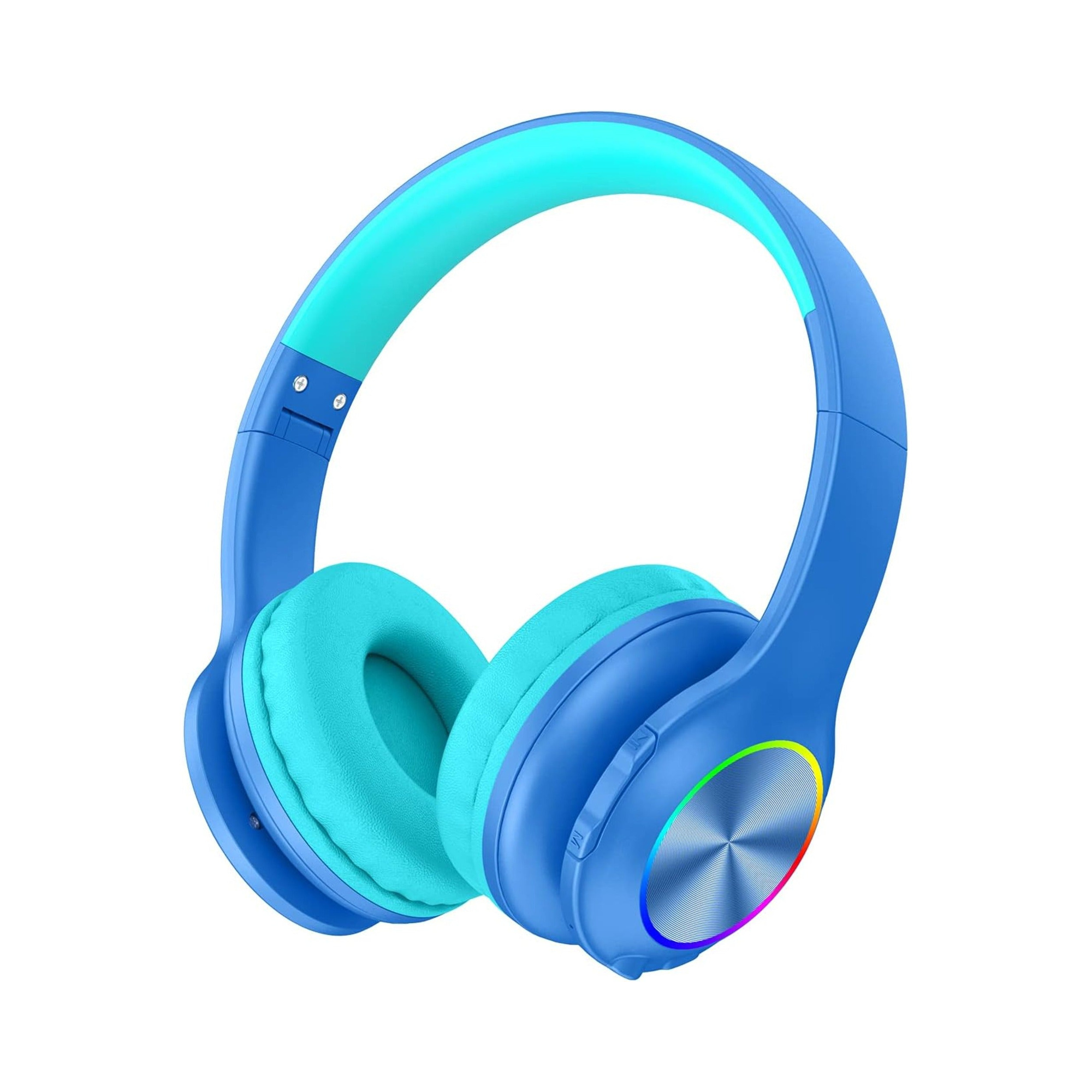
The Kids Volume-Limited Wireless Headphones, $22.99 as the listing stands, is the pair with a stated limit. The text states a "safe 94 dB limit", up to 85 hours of playtime, USB-C charging, a wired mode with the included cable, a TF card slot and Bluetooth 6.0. It describes an HD noise reduction mic, a call feature, and makes no claim to active noise cancellation.
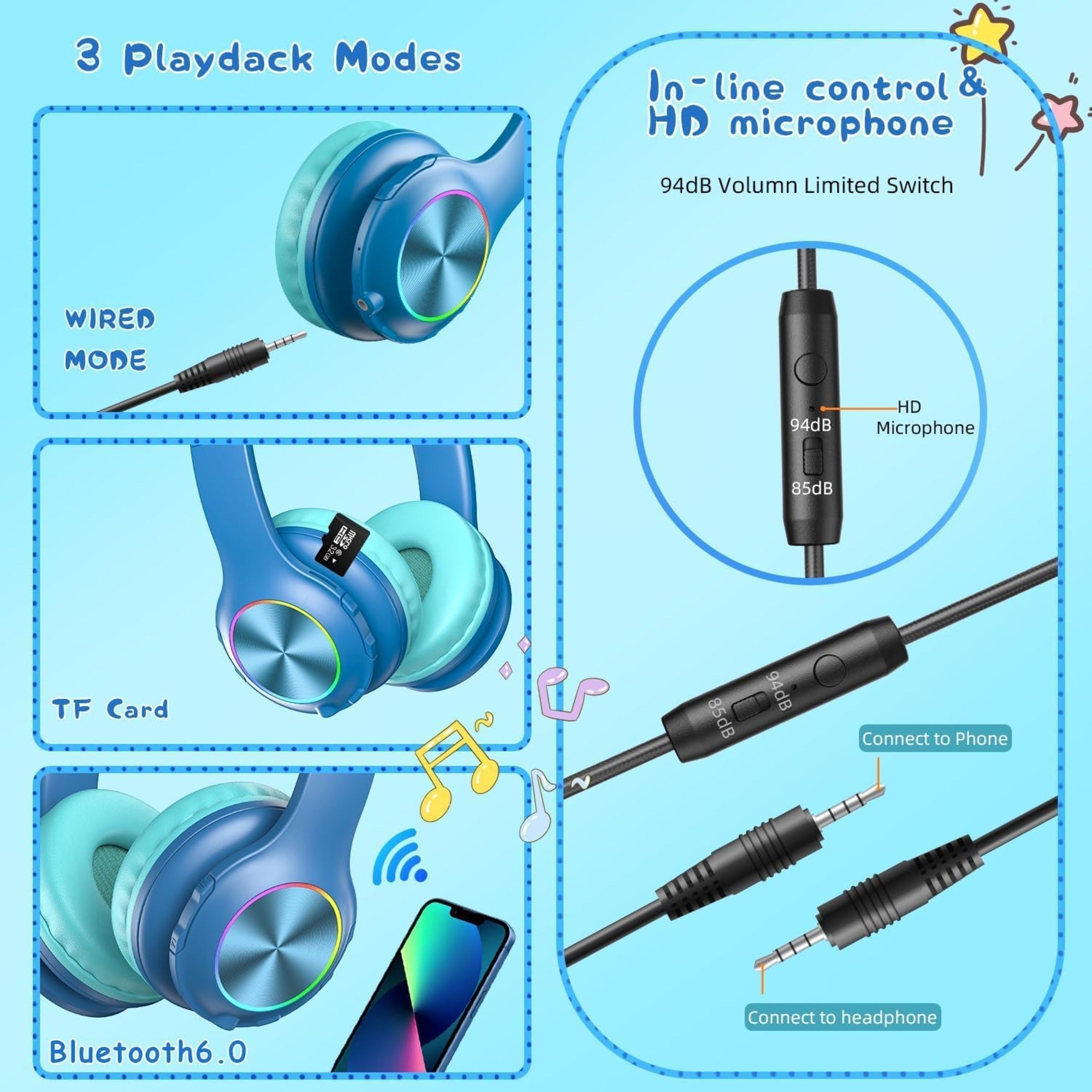
The text never mentions that switch; one gallery image shows it. It sits on the cable, so it can only act in wired mode; the page says nothing about Bluetooth or TF card playback, so ask us before relying on a cap there. Another gallery image says "aged 3-21"; the text gives no age. The listing calls the 94 dB limit safe; read against the figures above it is a ceiling, 9 dB above the NIOSH workplace recommendation, at the foot of the NIDCD's range for headphones at maximum volume and 19 dB above the WHO-ITU children's mode. If you buy this pair, the 85 dB position plus a time limit does more for a child than the cap alone.
Our other kids model, the Kids Wireless Headphones Series 185, has listing copy under correction, so we quote no volume figure from it; treat it as having no stated limit until the page says otherwise. Both sit in our everyday wireless collection.