

On our earbuds, ANC and ENC are unrelated features that share two letters. ANC quietens steady low-frequency sound before it reaches your eardrum; ENC cleans the signal leaving your microphone so a caller hears less of your surroundings. So does noise cancelling block voices? Not at any price: earbuds that list only ENC change nothing you hear, and no ANC design cancels a voice two desks away, because the limits come from the speed of sound and a 2.5 cm ear canal.
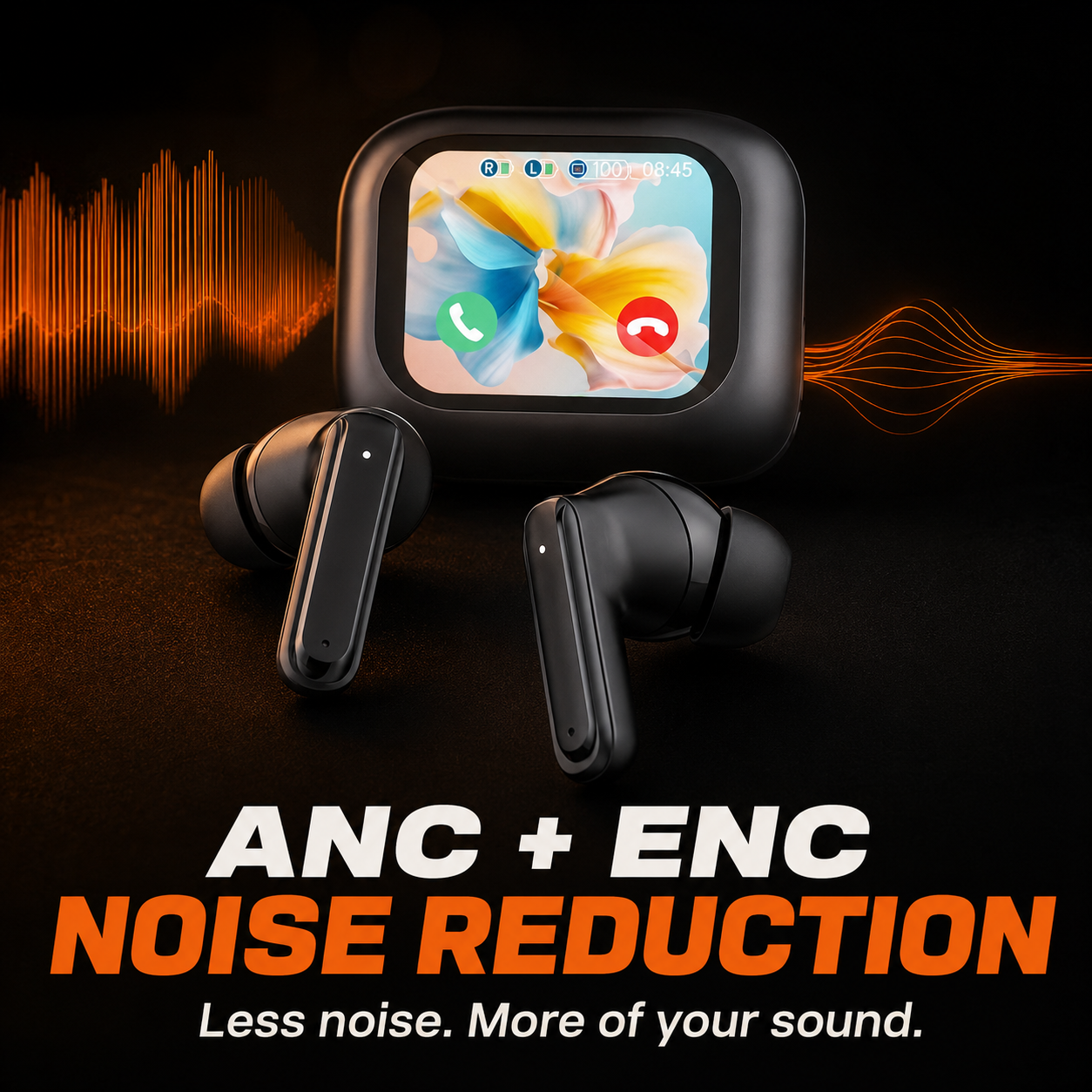
ANC works on your ear; ENC works on your microphone
Active noise cancellation samples the sound around the earbud with a microphone and drives the speaker with an inverted copy, so the two partly cancel at your eardrum: in Scientific American's words, "a sound wave with the same amplitude but with inverted phase" that combines with the original and cancels it. It runs on calls and off them, and your caller never hears the result.
Environmental noise cancellation is processing applied to your outgoing voice: the microphones pick up you plus the room, a chip estimates which part of the mixture is steady background and subtracts it, and the cleaned signal goes over Bluetooth. Only the person at the other end hears the difference; your own listening does not change by a decibel.
Passive isolation, the third item on the same spec line, is what both build on: a silicone tip sealing the canal blocks a share of outside sound before any circuit runs, so if the tip does not seal, ANC has more to fight and ENC a noisier room to subtract. Run the four seal checks first.
How ANC works: the anti-noise has a budget measured in microseconds
Two identical waves, one inverted, sum to zero. In a real ear the anti-noise is always slightly late and slightly wrong in level, and what you hear is the leftover. With equal levels and a phase error of θ, the residual is 2·sin(θ/2) of the original: at 10° about 15 dB of reduction, at 20° about 9 dB, at 60° nothing, and at 90° 3 dB louder. Level is more forgiving: 20 dB of reduction needs the amplitude within about 1 dB, 10 dB within about 3 dB.
Phase error is timing error in other units. OpenStax College Physics gives the speed of sound in air as 343 m/s at 20 °C; take 20°, the row worth 9 dB, as the tolerance, and the budget shrinks as frequency rises because each cycle is shorter.
| Frequency | One cycle | Budget for 20° (about 9 dB) | Sound travels in that time |
|---|---|---|---|
| 100 Hz | 10 ms | 556 µs | 19 cm |
| 1 kHz | 1 ms | 56 µs | 19 mm |
| 4 kHz | 250 µs | 14 µs | 4.8 mm |
At 100 Hz the electronics can run 19 cm of sound late and still take 9 dB off an engine drone. At 1 kHz the whole margin is roughly the distance from the outside of the shell to your eardrum; at 4 kHz it is thinner than the shell. That is why cancellation is kept off the ordinary audio path: Bluetooth decoding and digital filtering buffer for hundreds of microseconds or more, so ANC runs on a separate, much faster path, often analogue, with the music mixed in afterwards.
The same arithmetic decodes a figure on one of our listings. The Series 215 states that its adaptive hybrid ANC can "react to changing noise in as little as 0.02s". Sound travels 6.9 m in 20 ms, so that cannot be the cancellation delay; it is how quickly the filter re-tunes as the noise around you changes character, a far slower loop. A reaction time quoted in milliseconds is an adaptation figure.
Why a 2.5 cm ear canal caps ANC near 3 kHz
Cancellation is a claim about one place: you want the pressure at your eardrum near zero, but the microphone sits somewhere else. StatPearls describes the external auditory canal as "an approximately 2.5-cm S-shaped conduit extending from the conchal bowl to the tympanic membrane"; whether quiet at the microphone means quiet at the drum depends on how that 2.5 cm compares with the wavelength.
At 100 Hz the wavelength is 343 ÷ 100 = 3.43 m, so the canal is under one per cent of a wavelength and the pressure along it is essentially uniform. A 2.5 cm tube closed at one end resonates at a quarter wavelength, 343 ÷ (4 × 0.025) ≈ 3.4 kHz, and around there the approximation breaks: pressure at the microphone and at the drum stop agreeing, and no processing can correct what the system has no sensor to see. The ceiling is set by the speed of sound and the size of a human ear; money buys refinement below it rather than reach above it.
Where the microphones sit decides how the budget is spent, and it is rarely printed on a box. A feedforward microphone faces outward and hears noise before it reaches you, so travel time becomes processing time; it never checks its result, so it assumes a model of your ear and seal, and it stands in the wind. A feedback microphone sits inside, facing your ear, and measures what got through; it corrects for your actual fit but cannot act until the noise has arrived. Hybrid uses both, and of the listings below only the Series 215 names an arrangement.
Wind is the outer microphone's failure: air moving across the port creates turbulent pressure at the diaphragm that is not sound and would never reach your eardrum, and a feedforward system synthesises anti-noise for it anyway. The roar on a windy platform is an accurate cancellation of a noise that never existed; the most useful wind mode is the off switch.
How ENC works, and why it changes nothing you hear
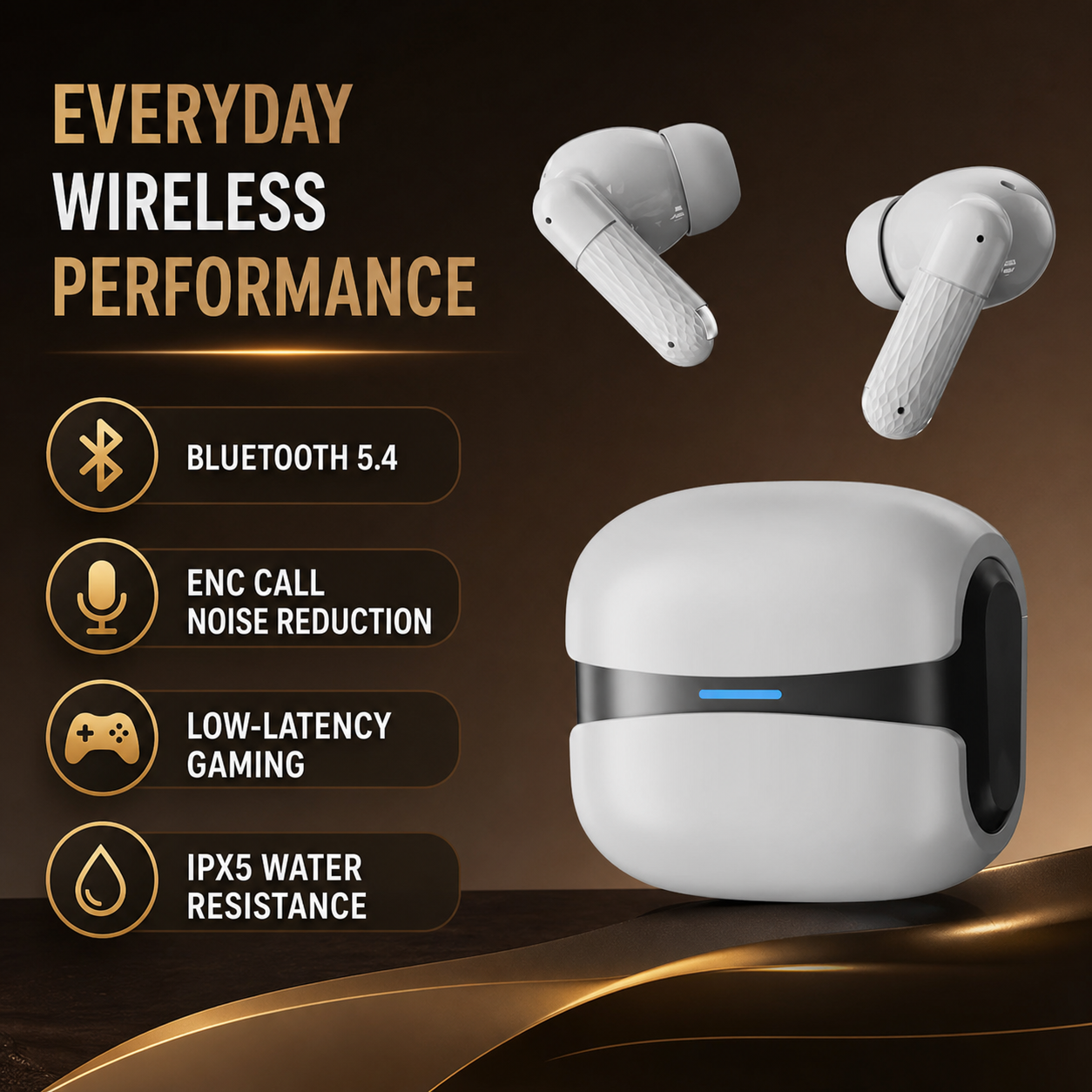
ENC has no timing budget to speak of, because nothing is cancelled in the air: your voice and the room arrive at the microphones together, and the chip can take a few milliseconds over the recorded mixture without anyone noticing. A mouth a few centimetres away and a bus engine several metres away reach two microphones differently, and a steady sound has a spectrum that can be estimated and subtracted. The Cloud White names a second stage for the same job, "ENC call noise reduction with CVC voice processing", to help the microphone "focus on your voice".
What improves is one thing: how you sound to a caller in steady noise. You hear the caller through playback, so their clarity depends on their microphone and your fit, and ENC has no part in it. A keyboard or a closing door is harder to estimate than a fan, and wind hits the same outer ports. The Cloud White's page puts the limit in one line: "They do not cancel noise in your own ears. Any quiet you experience comes from the passive seal of the in-ear fit, not electronics." To find out whether an ENC claim holds up, record yourself before a call in the noise you work in.
What neither feature can do
Neither cancels speech, and the reasons stack. Typical speaking fundamentals sit near 100 Hz for men and 200 Hz for women, inside ANC's band, but the parts of a voice that make words intelligible sit far higher: a 2014 paper in Frontiers in Psychology summarises work in which filtering out a 3.5–10 kHz band cut consonant identification in noise by more than filtering out low-frequency bands did. ANC strips the body from a voice and leaves the consonants that carry the meaning. Speech also refuses to sit still, so a filter built for drone is always chasing it, and hearing is built for exactly this signal.
ENC does nothing for your ears, and ANC does nothing for your caller. Neither helps with a door slam, a dog or an alarm, which are over before a filter has modelled them, and both are defeated by wind. Neither is a measured rating: a decibel figure that states no method compares to nothing, and we have measured none of the pairs we sell. Neither replaces the seal, which is why the first change for a disappointing pair is usually a different tip size.
The one thing ANC reliably does for your hearing is indirect: the World Health Organization's safe-listening guidance recommends well-fitted, noise-cancelling headphones so that you do not need to raise the volume in noisy places, and puts the weekly budget at 80 dB for up to 40 hours. A quieter background helps only if you leave the volume where it was.
If a product causes pain, irritation, ringing or a noticeable hearing change, stop using it and seek qualified care.
Reading the noise line on our listings
Our product pages use the labels in three patterns; read the noise-control line in the spec table before the product name.
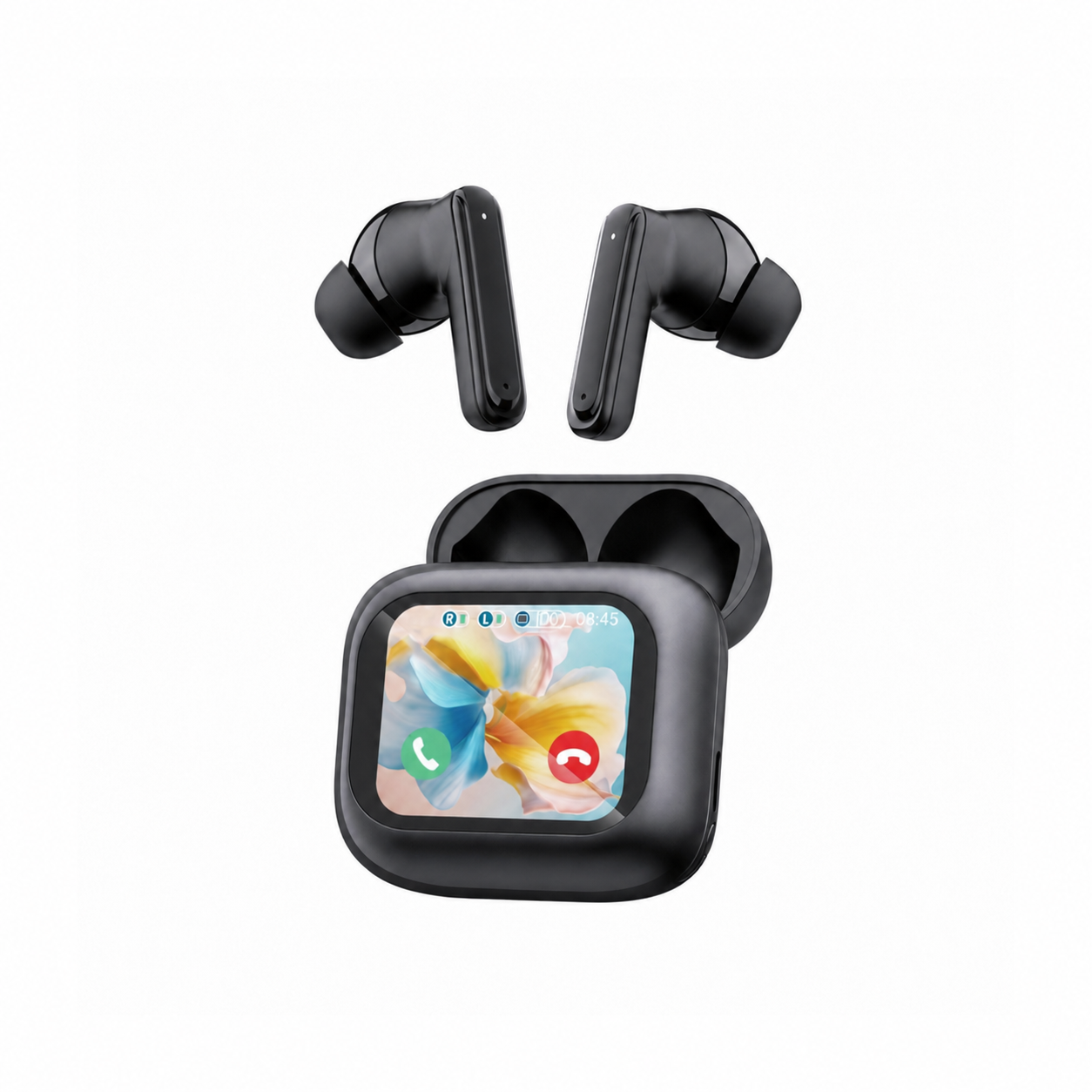
- Both labels. The Smart Wireless Earbuds with LCD Touchscreen Case, $49.99 at the time of writing, list "ANC and ENC" for "listening and voice calls" and add the limit: "nearby voices and sudden sounds still get through".
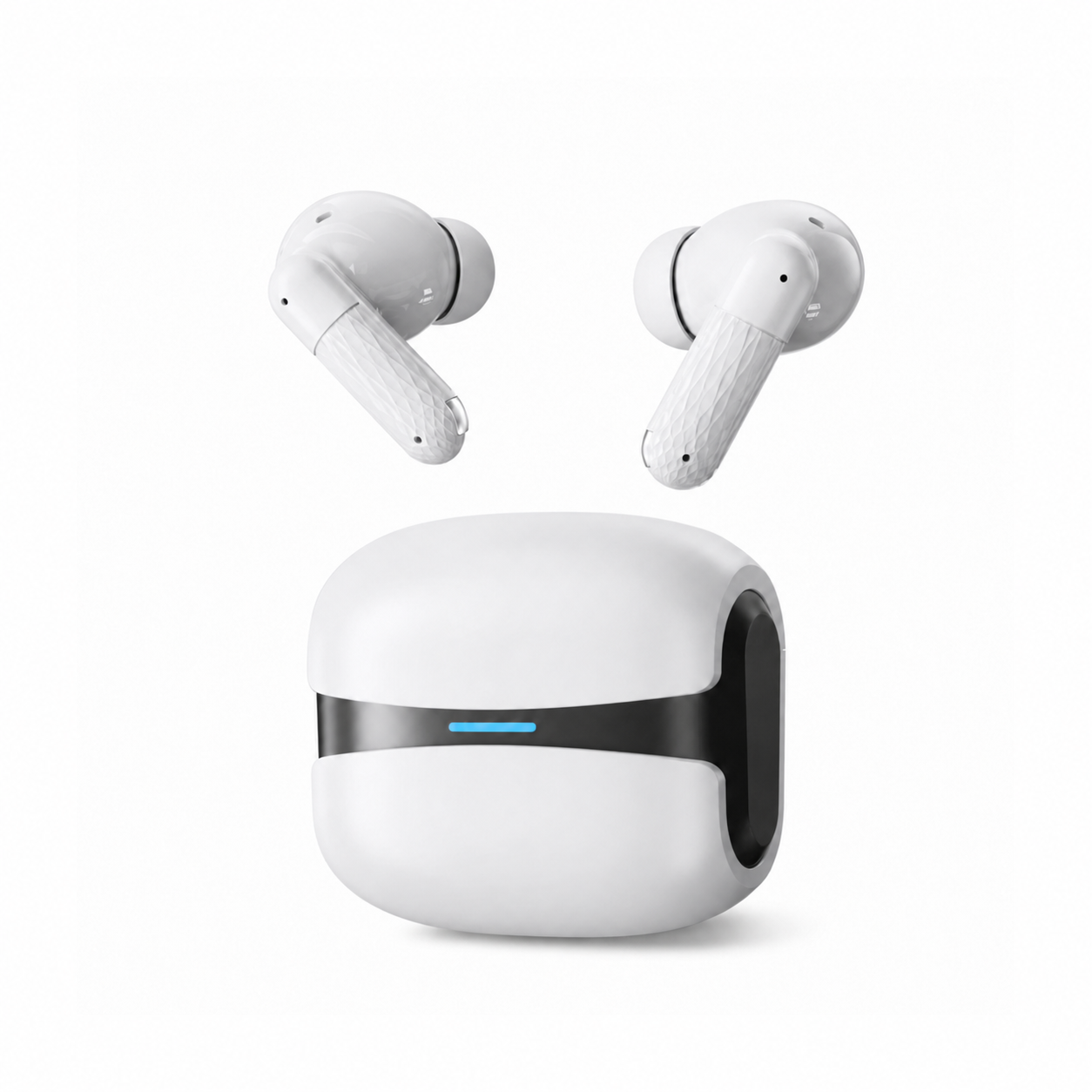
- ENC only. The Cloud White Bluetooth 5.4 earbuds, $25.99 at the time of writing, list "ENC call noise reduction with CVC voice processing" and nothing on the listening side. Expect a passive seal and cleaner calls.
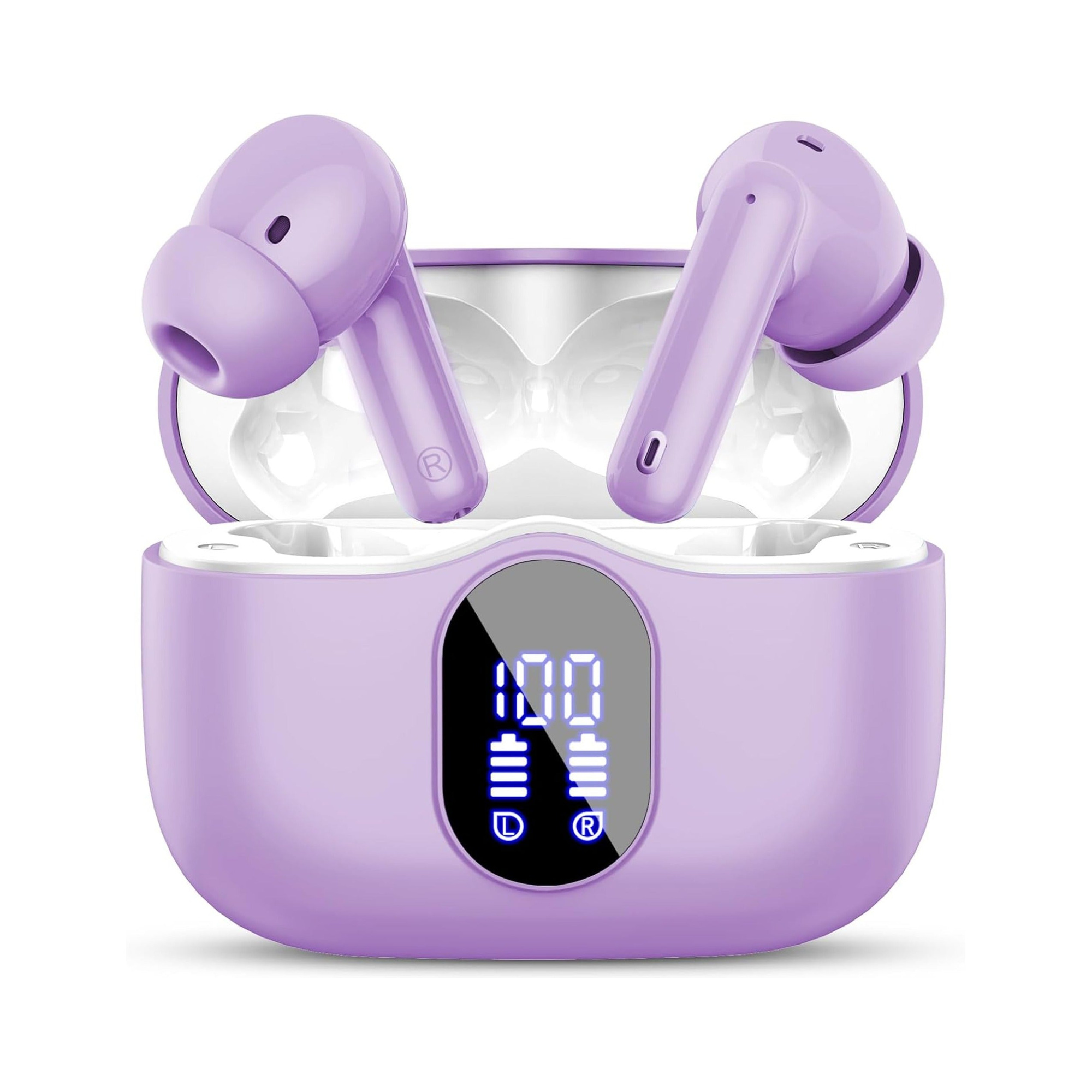
- A name that promises more than the spec line. The Noise Cancelling True Wireless Earbuds, $27.99 at the time of writing, carry the phrase in their name, but the description's noise feature is "ENC calling noise cancellation" for calls; it does not state ANC. Read them as the Cloud White pattern.
- Placement stated. The Series 215, $51.73 at the time of writing, names "Adaptive Hybrid ANC" and a transparency mode; its 0.02 s figure is the adaptation time above.
Across the everyday wireless earbuds range, ENC wording is far more common than ANC wording, so "noise cancelling" without the letters ANC usually describes calls. Noise in your own ears: check the ANC line and the tip sizes in the box. Noise in your caller's ears: check the ENC line and make a test recording.
- OpenStax, College Physics 2e, 17.2 Speed of Sound, Frequency, and Wavelength: 343 m/s at 20 °C.
- StatPearls: Anatomy, Head and Neck: External Ear: the 2.5 cm canal.
- Scientific American on how active noise cancellation works (2014).
- Monson, Lotto and Story, Frontiers in Psychology (2014): speaking fundamentals; the 3.5–10 kHz band and consonants.
- WHO: Deafness and hearing loss, safe listening: 80 dB for 40 hours a week.