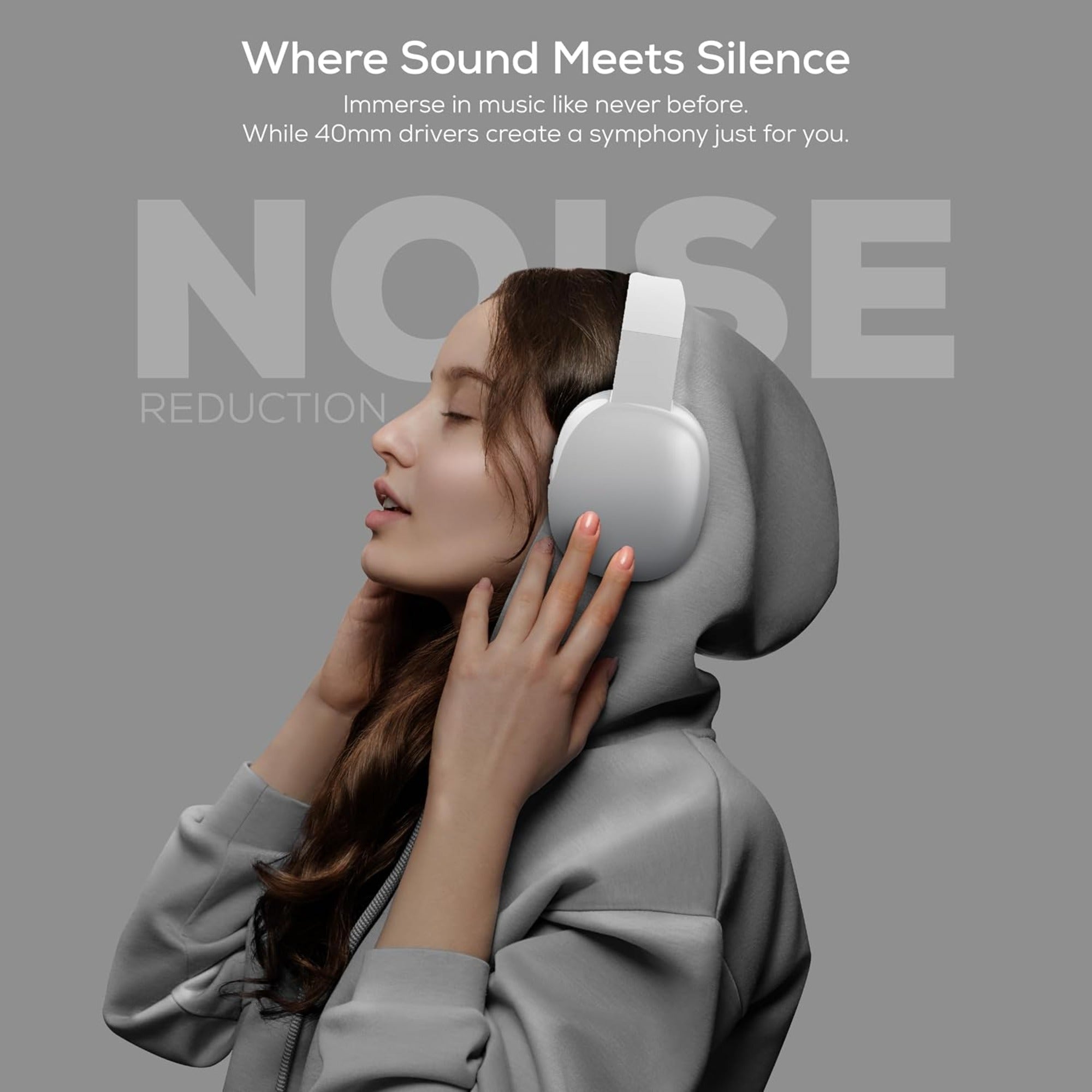


People shopping for over the ear earphones wireless almost always mean full-size Bluetooth headphones with cups that enclose the ear instead of sitting inside it. They are very good at stationary listening and predictably poor at four or five common situations. The form factor decides more than the model does, so settle the shape first.
A headphone that scores well on a test bench can still be wrong for your face, your commute or your climate, and none of the five failures below appears on a spec sheet.
Over-ear, on-ear and in-ear are three different things
Retail listings blur these constantly, and the phrase "over the ear" gets applied to at least three unrelated designs. The distinction is worth thirty seconds because it determines where the pressure lands.
| Design | Where the pad sits | Pressure lands on |
|---|---|---|
| Over-ear (circumaural) | Surrounds the ear, sealing against the side of the head | Skull and soft tissue around the ear |
| On-ear (supra-aural) | Rests directly on the outer ear | Ear cartilage itself |
| In-ear / earbud | In or at the entrance of the ear canal | Canal walls and concha |
On-ear models are frequently sold under over-ear search terms. They are lighter and pack smaller, but pressing on cartilage for two hours is a different experience from pressing on the skull, and people who find one uncomfortable often tolerate the other fine. If a listing does not say which it is, the photos usually settle it: check whether the pad opening is larger than an ear.
Five ways over-ear fit fails
Glasses break the seal, and the seal is doing the work
An over-ear headphone's bass response and its noise cancelling both depend on a continuous seal between the pad and your head. A spectacle temple arm runs straight through that seal and holds open a small channel. The usual result is thinner low end, noticeably weaker cancellation, and a pressure point where the arm is pinched against the side of your head.
The follow-on problem is the one worth watching: when isolation drops, most people raise the volume to compensate instead of noticing the seal has failed. Listening louder for longer is the mechanism behind noise-induced hearing loss, as the NIDCD explains, and the WHO safe-listening guidance covers the exposure side. Thicker, softer pads help somewhat. Thin frames help more. We have written separately about earbuds for people who wear glasses, which sidesteps the problem entirely.
The cup can be shallower than your ear
"Over-ear" describes the pad opening, not the internal depth. If the cavity is shallow, the top of your ear touches the driver housing, and that contact usually becomes a hot spot somewhere between twenty and forty minutes in, long after the in-store try-on has ended. Ears that protrude, or that are simply tall, run into this more often.
The check is straightforward: measure your ear from the top of the helix to the bottom of the lobe, then look for the cup's inner opening dimensions in the listing. Most listings, ours included, do not publish that figure. Treat the absence as a reason to buy somewhere with a return policy. People at the other end of the range have a mirror-image problem, which we cover in earbuds for small ears.
Heat is the trade you make for isolation
The pad material that seals best also breathes worst. Protein leather and similar coated foams give a good acoustic seal and a soft feel, and they trap heat and moisture against your head. In a cool office this is unnoticeable. In a warm room, on a summer commute, or during anything resembling exercise, it becomes the reason you take them off.
There is no clever fix. Velour and mesh pads breathe better and seal worse, which costs bass and cancellation. If your listening is mostly warm-weather or mostly active, that trade generally points away from over-ear altogether and toward open-ear or in-ear designs, which put nothing over the ear at all.
They do not work lying down
This one is simple geometry. A rigid cup between your ear and a pillow is uncomfortable within minutes and cannot be made to work on your side, whatever the price or padding. Anyone shopping for something to fall asleep in should be looking at flat in-ear or headband designs instead; see side sleeper earbuds.
Folding is not the same as portable
Most over-ear models fold, which reduces the volume they occupy without making them pocketable. Our own over-ear model folds, rotates its cups up to 105 degrees and ships with a travel pouch, and its listing gives the weight as roughly 0.54 lb, around 245 g. That is fine in a backpack and awkward in a jacket. If your listening happens in transitions instead of at a desk, that weight is carried far more than it is worn.
A three-minute check before you buy
- Decide where you will use them for most hours: desk, transit, bed, gym, or moving between all four. Only the first two favour over-ear.
- If you wear glasses, accept that cancellation and bass will underperform the reviews, and factor that in.
- Measure your ear top to bottom and look for the cup's inner opening dimension. If it is not published, plan on returning them if the fit is wrong.
- Check whether a wired fallback is included. A 3.5 mm input keeps the headphones useful on a flat battery and on older in-flight systems.
- Treat comfort claims as marketing and the return window as the thing that protects you.
The full-size shape inside an earbuds catalogue
Our range is overwhelmingly in-ear, and this is not a category where we can claim breadth. There is one true over-ear model, a run of gaming headsets that share a chassis, and one kids' headphone. Our collections are even named for earbuds, which is why the over-ear model sits inside an earbuds collection.
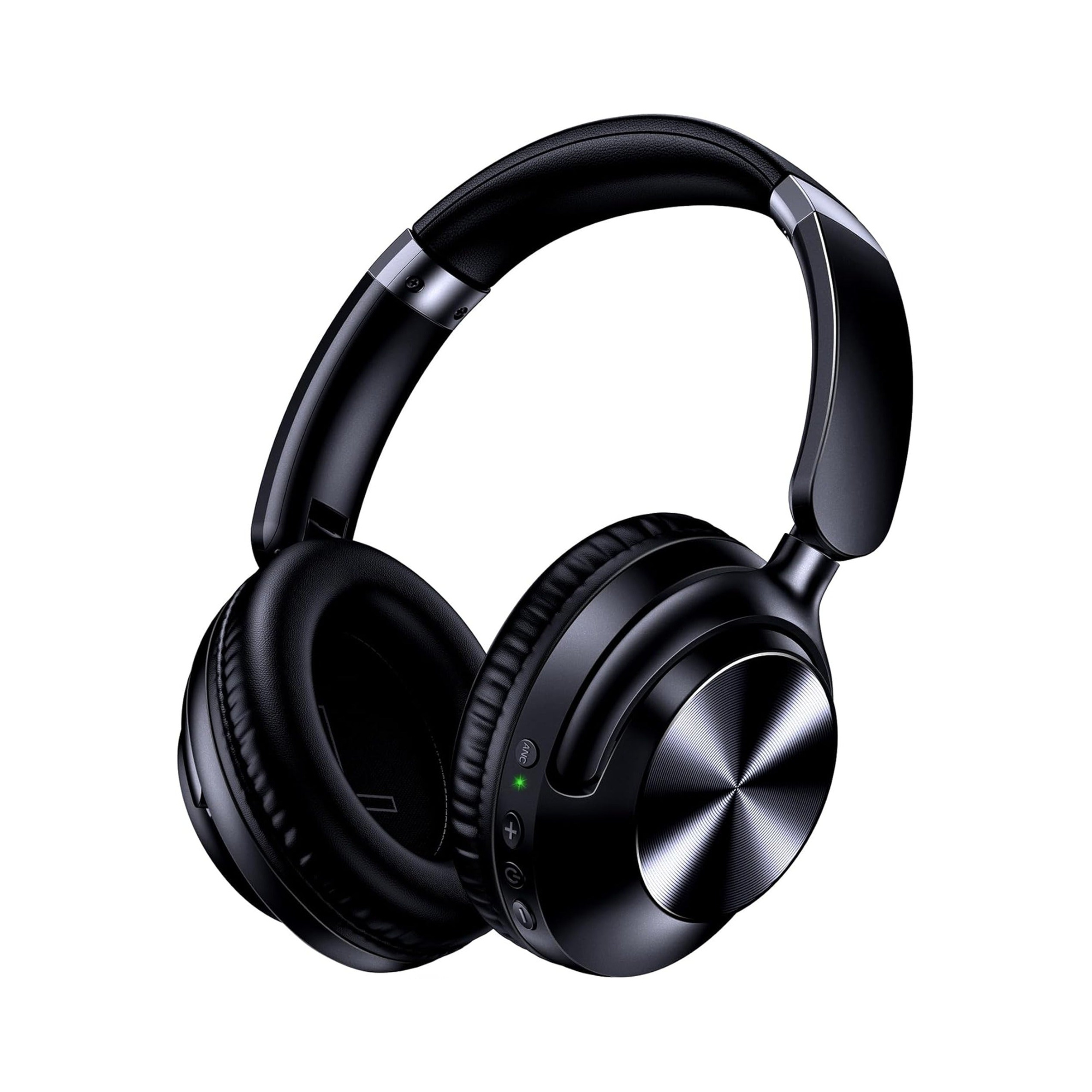
The Over-Ear Wireless Headphones Series 127 costs $44.75 at the time of writing, and the specifics we can stand behind are the ones printed on the listing: up to 100 hours of playback per charge, a fast-charge claim of 10 hours of listening from five minutes, Bluetooth plus a 3.5 mm wired mode with a 47.2-inch cable, protein leather pads, and an adjustable headband. The listing also carries a supplier percentage figure for ambient noise reduction that we cannot verify and have removed from our own copy. Our ANC versus ENC explainer covers why those two acronyms get conflated on listings like this one.
The Wireless Gaming Headset Series 186 at $33.34 is over-ear, runs over Bluetooth or 3.5 mm, and has a built-in mic instead of a boom; its siblings are the same chassis in different finishes. The Kids Volume-Limited Wireless Headphones at $22.99 fold, cap output at 94 dB and take a 3.5 mm cable. If you want a boom mic for team voice, that is a real gap in our range.
When over-ear is genuinely the right call
None of the above is an argument against the shape. There are situations where cups win comfortably:
- Long sessions at a desk. Nothing sits in the canal, so canal fatigue and pressure never build. This is the strongest case for over-ear and the reason it dominates office use.
- Long-haul flights. Cabin noise is low-frequency and steady, which is what cancellation handles well.
- Cold weather. The heat problem inverts and becomes a feature.
- Sensitive ear canals. If in-ear tips cause soreness, moving the contact point off the canal often solves it.
- Battery headroom. Larger housings hold larger cells, which is why triple-digit playtime figures appear on over-ear models and not earbuds.
If none of those describe your week, the shape is probably not the one to buy, and everyday wireless earbuds will likely serve better for less.
Two questions about the words on over-ear listings
Does "over-ear earphones" mean cups or ear hooks?
It means one of two unrelated products, and the shortlists do not overlap. Full-size headphones enclose the ear inside a cup; ear-hook earbuds loop a wire over the top of the ear and sit at the canal. Decide which you meant before you compare anything, because every trade-off above applies to the first and almost none of it to the second.
Can a product be both over-ear and an earbud?
No. "Earbuds" sit in or at the entrance of the ear canal; "over-ear" describes cups that enclose the whole ear. The two wordings get merged in product titles, which is where the confusion starts. Pick the shape from the trade-offs above, then compare within it.
Which shape, then
Over-ear wireless headphones are right for desks, flights, cold weather and long sessions, and wrong for sleeping, sweating, and anything you carry more than you wear. Glasses and cup depth cause more returns than sound quality does, and neither shows up in a spec sheet. Decide the form factor first, check the return policy second, compare models last. Our own range here is one over-ear model at $44.75 plus a set of gaming headsets, which is useful if the shape suits you and no help at all if it does not.