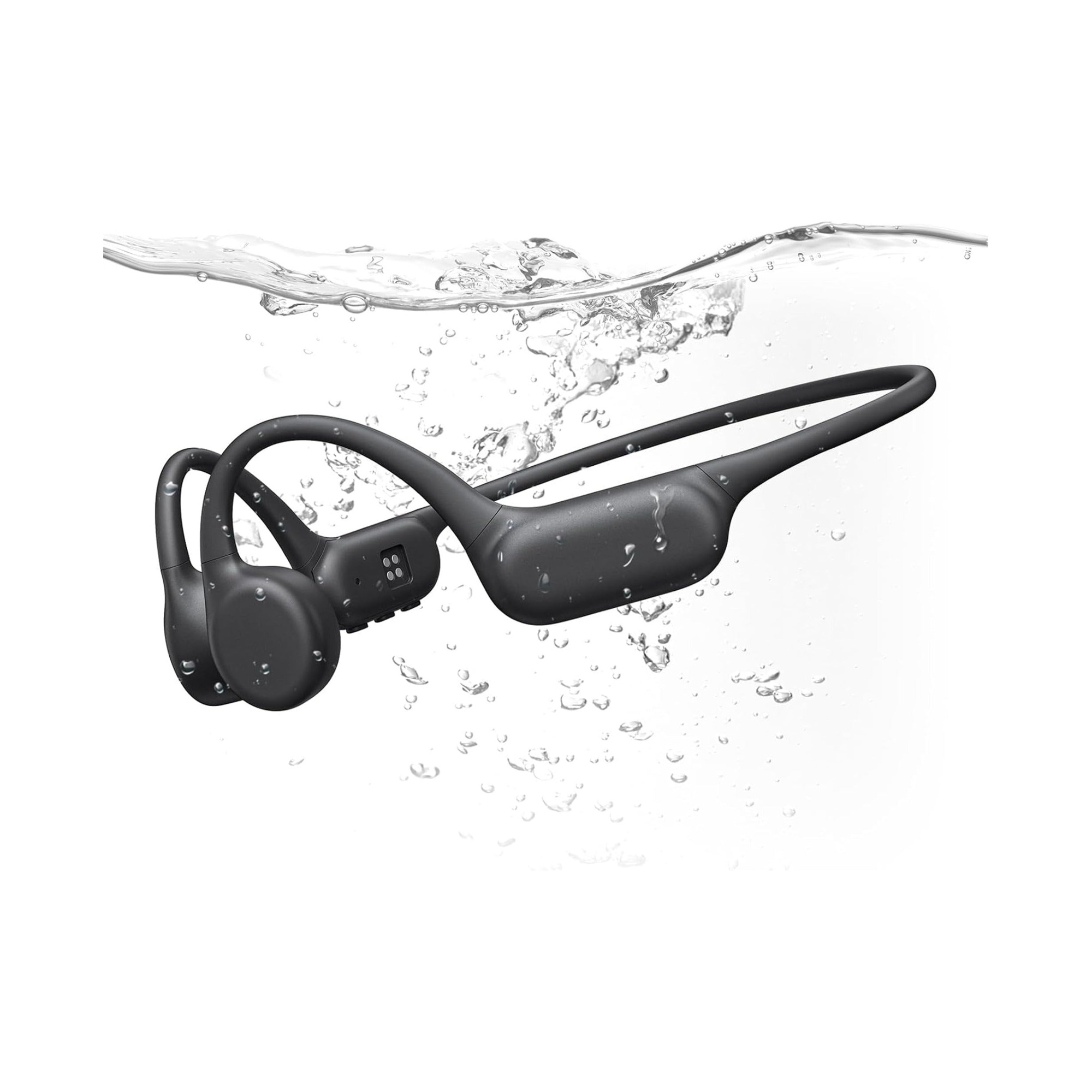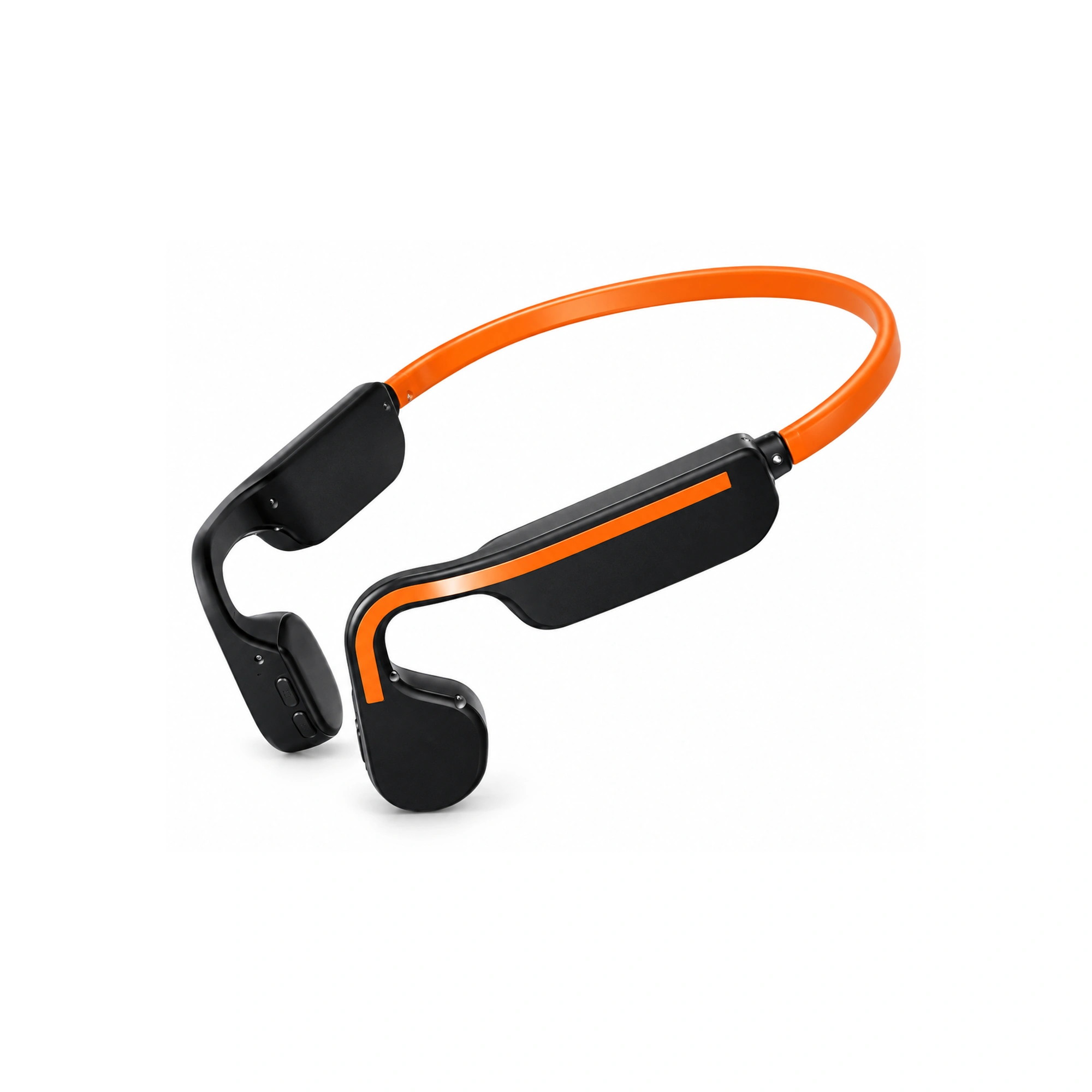


An IPX8 waterproof earbuds rating under IEC 60529 means an audio enclosure is engineered to survive continuous submersion in water deeper than one meter (at least three feet, and typically 1.5 to 2 meters depending on the manufacturer’s specified test depth) for more than 30 minutes. While an IPX7 waterproof earbuds rating stops at temporary 1-meter immersion for up to 30 minutes, ipx8 earbuds are built for sustained underwater exposure during lap sessions. Even so, surviving submersion is only half of the equation: 2.4 GHz Bluetooth radio waves attenuate rapidly underwater, water sneaking past an ill-fitting silicone ear tip muffles in-ear drivers, and capacitive touch panels often misfire when wet. Choosing dependable waterproof earbuds for swimming therefore comes down to pairing continuous-submersion sealing with a mechanical frame that locks onto your head—such as the open-ear angular Black Cyan-Trim Swimming Headphones ($44.99) or the curved in-ear Yellow Wraparound Swimming Headphones ($44.99)—and following a strict post-swim chlorine rinse routine.
What Continuous Submersion Under IEC 60529 IPX8 Actually Covers Beyond 1 Meter
Shoppers comparing waterproof swimming headphones frequently assume that every high IP code represents the exact same laboratory test. Under the IEC 60529 ingress protection standard, IPX7 has a fixed baseline: immersion up to one meter (approximately 3.2 feet) for 30 minutes or less. As clinical audiologist Dr. Amy Sarow, AuD, CCC-A notes in Soundly’s waterproof earbuds guide, a rating of IPX7 works in humid or moist environments or for swimming laps in the pool for 30 minutes or less, and IPX7 is not meant for submerging in water beyond one meter or for long periods of time.
By contrast, as Dr. Amy Sarow notes in Soundly’s guide, an IPX8 can be submerged in at least three feet of water for longer duration, and IPX8-rated models with nano-coating allow for submersion in up to 1.5 meters of water for 30 minutes or more. Two engineering details matter when you translate that rating to a real swimming pool:
- Manufacturer-Defined Depth and Duration: Because IEC 60529 requires IPX8 test conditions to be stricter than IPX7 while leaving the exact depth and time to the manufacturer, some ipx8 waterproof earbuds are tested at 1.5 meters for 30 to 60 minutes with internal nano-coating, while others are rated to 2 meters for multi-hour swim sessions.
- Dynamic Wall Push-Offs vs. Static Tank Depth: Laboratory immersion tests place an enclosure in calm, static fresh water. During freestyle flip turns or breaststroke frog kicks off the pool wall, water velocity against the earpiece nozzle and acoustic mesh creates localized dynamic pressure spikes that exceed static 1.5-meter head pressure. True wireless buds without a rear stabilizing band often shift during that push-off, breaking both the mechanical fit and the acoustic seal.
| Rating / Design Factor | IPX7 Splash & Short Immersion | IPX8 Continuous Submersion | Pool Lap Impact |
|---|---|---|---|
| Standard Depth Threshold | Up to 1 meter (approx. 3.2 feet) | At least 3 feet (commonly 1.5 m to 2 m) | Flip-turn push-offs add dynamic water pressure beyond static depth |
| Duration Benchmark | 30 minutes or less | More than 30 minutes (continuous) | Covers 45–60 minute continuous lap workouts |
| Wireless Signal in Water | Bluetooth works at surface only | Bluetooth attenuates underwater | Submerged laps require local audio or surface-level head position |
| Recommended Frame Style | True wireless ear-hook or neck cable | Wraparound rear band (open-ear or curved earpiece) | Rear tension band prevents loss during wall push-offs |
The Ear-Canal Water Trap and Why Physical Side Buttons Matter Underwater
Even when an earbud’s internal circuit board survives submersion, swimmers regularly ask why their audio suddenly sounds faint or tinny two laps into a set. The culprit is the ear-canal water trap. Traditional in ear swimming headphones rely on a microscopic air column between the speaker diaphragm and your eardrum. If a freestyle head roll or flip turn pulls the silicone flange slightly loose, pool water floods that narrow canal. Once water sits directly against the driver mesh, acoustic impedance changes dramatically and volume drops to a muffled murmur until you stop at the wall, pull the bud out, and shake your ear dry.
As Dr. Amy Sarow explains in Soundly’s audiology review, earbuds designed for swimming and watersport use are typically equipped with earfins or shaped to stay put in the ear, keeping the ear dry, and ensuring the right fit helps to keep a tight seal in the ear and keep water out. On Reddit’s r/OpenWaterSwimming, a swimmer noted that because their ears are small they prefer earphones that have a variety of sizes, while another pool swimmer reported using a headset where their ears aren’t covered so they can still hear ambient sounds.
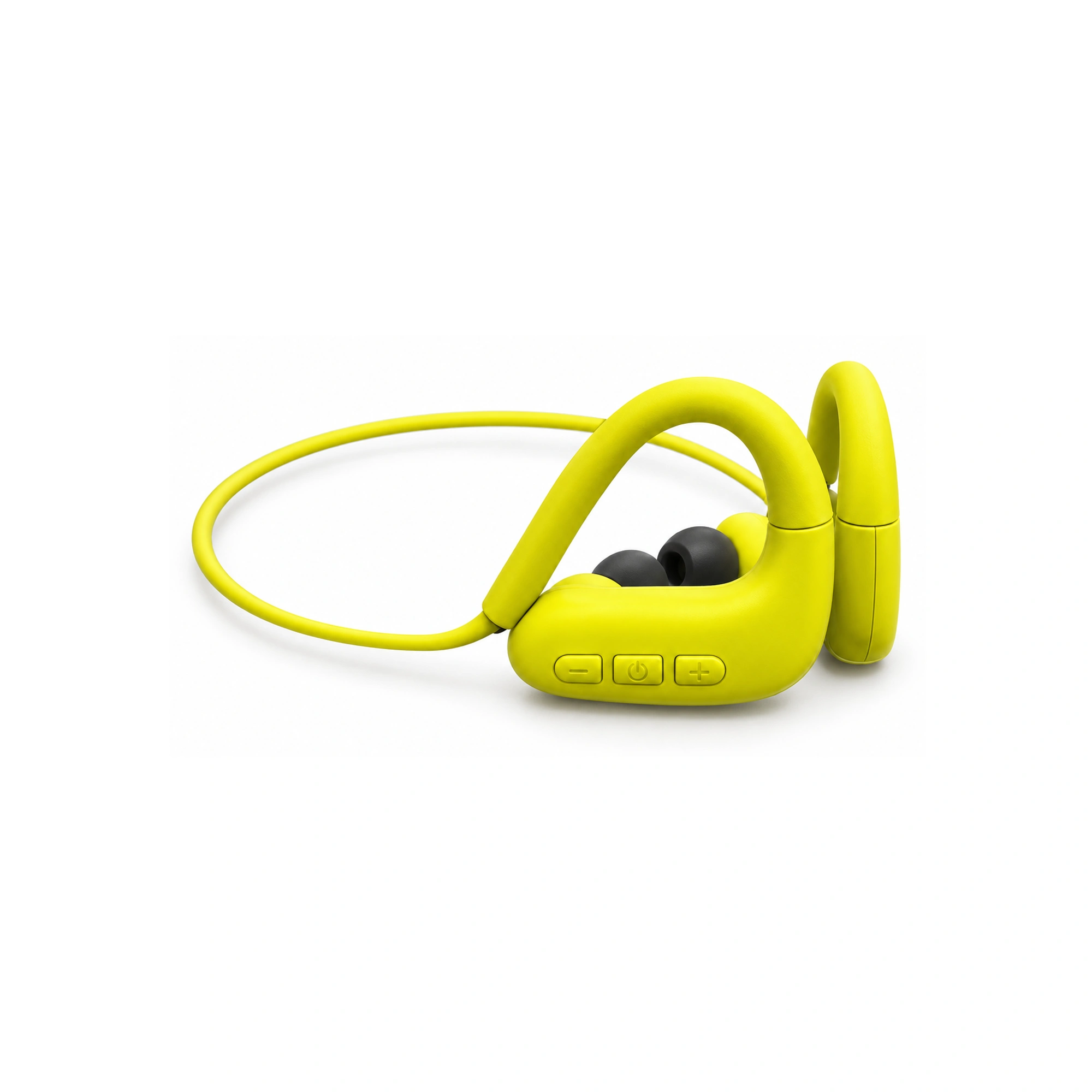
Control hardware is equally decisive. On Reddit’s r/Earbuds, a poster reported desperately looking for waterproof (minimum IPX7) earbuds with physical buttons or at least buttons that don’t react to water from swimming or showering. Capacitive touch sensors cannot distinguish between a finger tap and conductive pool water streaming across the shell, so raised mechanical side controls help prevent water contact from interrupting playback.
Comparing Angular Open-Ear vs. Curved In-Ear Wraparound Pool Architectures
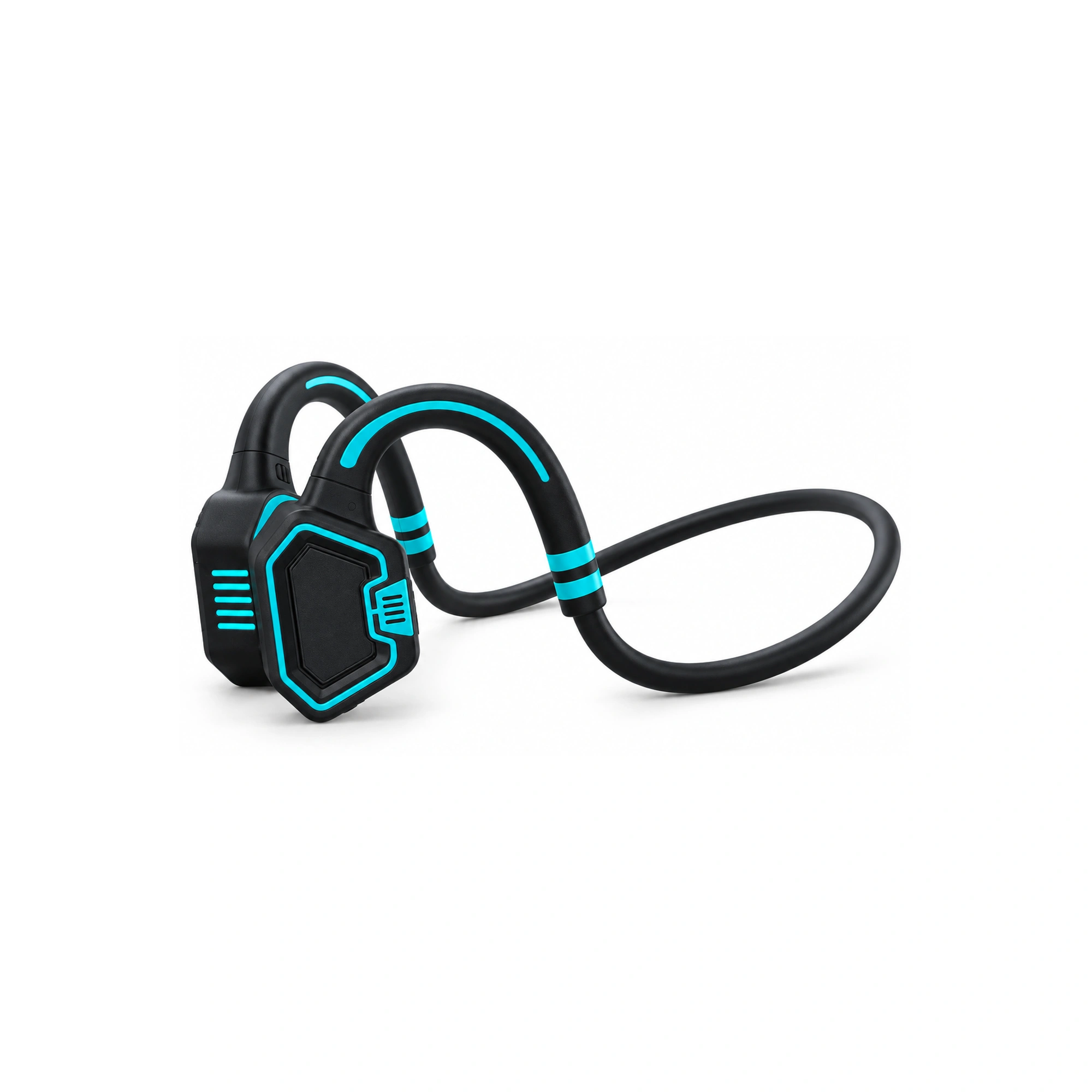
Instead of relying on two independent earbuds that can pop loose and sink to the bottom of a deep lane, wraparound swimming headphones join both earpieces with a continuous rear tension band that hooks over the ears. Within Earsole’s Swimming Headphones catalog, two models at the $44.99 price point illustrate the structural choice between an open-ear angular housing and a curved earpiece build:
- Black Cyan-Trim Swimming Headphones ($44.99, SKU
EAR-1688-1047802972981): Listed in the Earsole Swimming Headphones catalog at $44.99 (4499 cents) under SKUEAR-1688-1047802972981, Black Cyan-Trim Swimming Headphones features a wraparound band, cyan accents, angular housings, and side controls in a black and cyan finish. Because the angular housings rest against the outer ear region rather than plugging the ear canal, you avoid ear-canal pressure buildup and can hear lane-mates or deck whistles between intervals. - Yellow Wraparound Swimming Headphones ($44.99, SKU
EAR-1688-953304076027): Listed in the Earsole Swimming Headphones catalog at $44.99 (4499 cents) under SKUEAR-1688-953304076027, Yellow Wraparound Swimming Headphones features a wraparound band, side controls, curved earpieces, and a yellow finish. The curved earpieces direct sound toward the ear canal while the bright yellow finish is easy to spot on a wet pool deck or inside a swim bag.
| Feature / Specification | Black Cyan-Trim Swimming Headphones | Yellow Wraparound Swimming Headphones |
|---|---|---|
| Catalog Price & SKU | $44.99 (EAR-1688-1047802972981) | $44.99 (EAR-1688-953304076027) |
| Catalog Category | Swimming Headphones | Swimming Headphones |
| Housing & Fit Geometry | Wraparound band with angular housings | Wraparound band with curved earpieces |
| Control Interface | Side controls | Side controls |
| Color & Finish | Black and cyan finish with cyan accents | Yellow finish |
| Published IP / Storage Scope | Catalog confirms physical structure and controls; numeric IPX8 depth rating, internal MP3 capacity, and battery hours are not specified | Catalog confirms physical structure and controls; numeric IPX8 depth rating, internal MP3 capacity, and battery hours are not specified |
Catalog Scope Note: In keeping with transparent hardware reporting, the Earsole catalog listings for both the Black Cyan-Trim Swimming Headphones and the Yellow Wraparound Swimming Headphones confirm their wraparound bands, housing geometries, side controls, color finishes, and $44.99 pricing, but do not publish a laboratory-certified IPX8 depth figure, onboard MP3 gigabyte capacity, or battery runtime rating. Always verify whether your workout requires surface-level Bluetooth pairing or dedicated offline playback before submerging any headset.
Post-Swim Chlorine Rinse, Ear-Canal Drying, and Gasket Care Protocol
Even the toughest elastomer gaskets and hydrophobic nano-coatings degrade if pool chlorine or ocean salt is left to crystallize inside seams and charging pins. Adopting a three-minute post-swim routine protects both your hardware and your ears:
- Freshwater Rinse Immediately After Exiting the Pool: Gently rinse the wraparound band, over-ear hooks, and side control crevices under lukewarm, low-pressure tap water to dissolve sodium hypochlorite (pool chlorine) and salt residue before it dries.
- Dry Ear Canals and Silicone Tips Completely: Remove or wipe earpieces after rinsing so trapped moisture can evaporate. In Soundly’s waterproof earbuds guide, Dr. Amy Sarow notes that a properly fitting earbud can help keep water out, and drying the ear with a towel or low-heat hair dryer setting will help to remove any remaining moisture.
- Inspect Charging Contacts Before Connecting Power: Never attach a magnetic or USB charging cable while metal contacts are damp. Electrolytic corrosion happens in seconds when voltage meets chlorinated water. Let the headset air-dry on a towel for at least 30 minutes first.
- Cap Listening Volume Below 80 dB: Water splashing against your swim cap creates background noise that tempts swimmers to max out volume. As Dr. Amy Sarow states in Soundly’s guide, a good rule of thumb is to limit volume to 70% of maximum and keeping the volume below 80 dB is best to protect your hearing.
Frequently Asked Questions
Is IPX8 waterproof ok for swimming laps in a pool?
Yes, from an enclosure-sealing standpoint, an IPX8 rating is the industry benchmark for pool lap swimming because it covers continuous submersion in at least three feet of water for more than 30 minutes, whereas IPX7 is limited to one meter for 30 minutes or less. However, you still need a secure wraparound fit that resists wall push-offs and an audio transmission method that accounts for Bluetooth signal loss underwater.
Why do IPX8 earbuds still lose sound or connection underwater?
Two separate physical effects cause underwater audio dropouts. First, 2.4 GHz Bluetooth signals do not work underwater, so standard Bluetooth streaming cuts out as soon as your head submerges. Second, if water slips past an ear tip and enters the ear canal, it blocks the speaker driver from vibrating air cleanly, making the audio sound muted until the ear is dried.
Should I choose curved earpieces or angular wraparound housings for pool laps?
Choose an angular wraparound frame like the Black Cyan-Trim Swimming Headphones ($44.99) if you dislike ear-canal pressure or want to hear lane traffic and coach whistles at the wall. Choose a curved-earpiece wraparound model like the Yellow Wraparound Swimming Headphones ($44.99) if you prefer curved earpieces with side controls and a high-visibility yellow finish.