



IP68 Waterproof Bone Conduction Headphones and Dust-Tight Sealed Transducers
Lap swimming exposes audio equipment to immediate water ingress, chlorine corrosion, and radio signal loss. Swimmers need pacing cues or music during endurance workouts, but submerging conventional earbuds rapidly ruins drivers and internal electronics. Bone conduction technology bypasses the outer ear entirely, vibrating cranial bone structures to send sound straight to the cochlea. This acoustic path leaves the ear canals unblocked, preserving spatial awareness and letting swimmers wear protective silicone earplugs against pool water.
Submerging an audio headset creates distinct physical stresses. Flip turns and dives generate hydrostatic pressure spikes, dissolved chlorine attacks bare metals, and water absorbs high-frequency radio waves. Ingress protection ratings define precisely how well an enclosure withstands these conditions.
Understanding the structural difference between IP68 dust-tight enclosures and IPX8 continuous submersion ratings prevents accidental equipment failure in the pool.
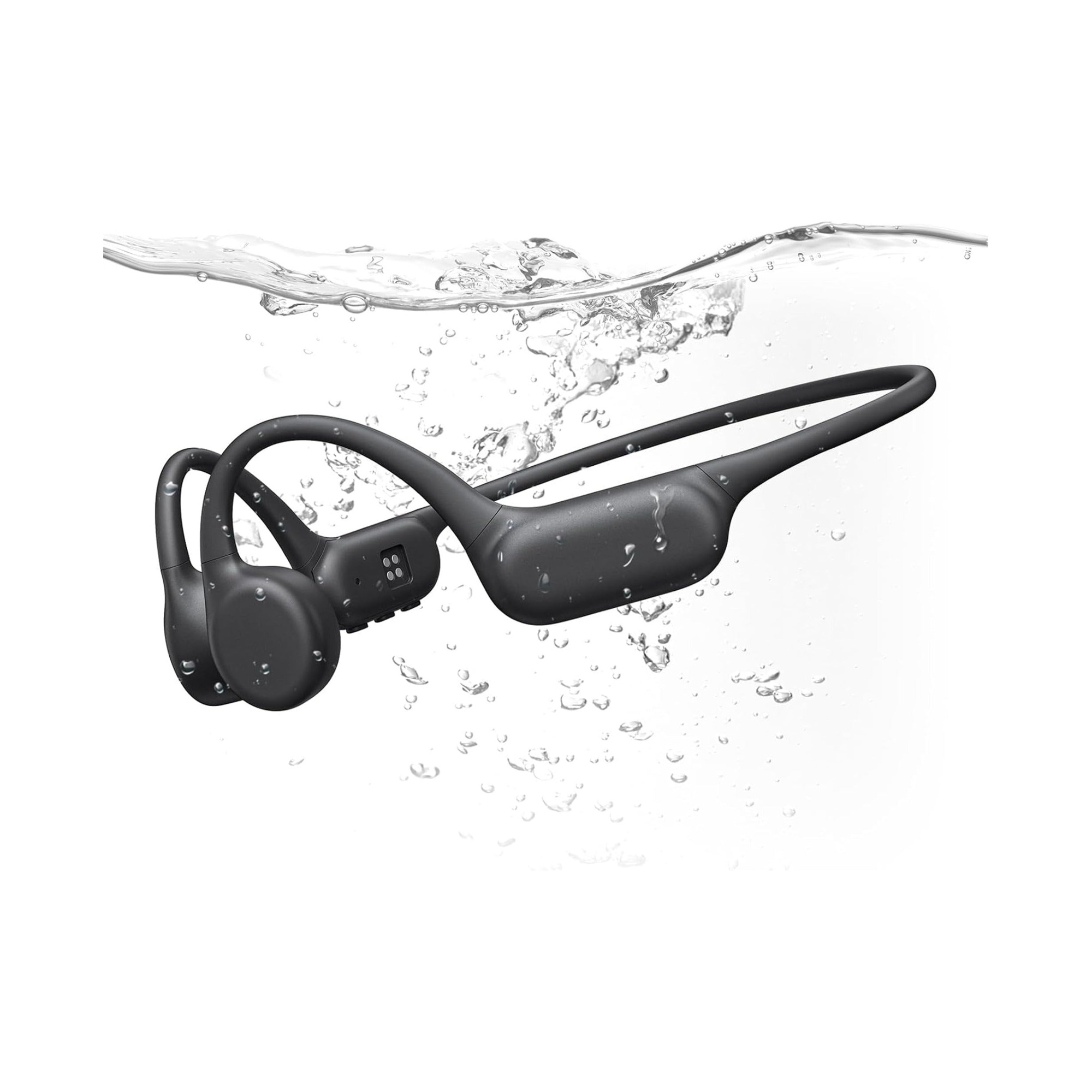
Ingress Protection Explained: IP68 vs IPX8 Enclosure Sealing
The International Electrotechnical Commission (IEC) standard 60529 establishes the ingress protection (IP) code system. The first digit measures resistance against solid particles and dust on a scale from 0 to 6. The second digit measures resistance against liquid ingress on a scale from 0 to 9.
When a device carries an IP68 rating, the “6” indicates total dust tightness, meaning no particulate matter can enter the internal chassis under specified vacuum test conditions. The “8” indicates continuous submersion in water under manufacturer-specified conditions of depth and duration, which must exceed the basic 1-meter, 30-minute threshold defined for level 7.
An IPX8 rating replaces the dust digit with an “X.” This designation means the manufacturer did not submit the product for formal fine-particle dust testing, concentrating entirely on liquid ingress testing. For pool and open-water swimming, the liquid rating is the critical benchmark. The EARSOLE Waterproof Swimming Headphones feature a certified IPX8 waterproof rating allowing submersion up to two meters for one hour. This rating guarantees protection against hydrostatic pressures encountered during lap swimming, drills, and surface water sports.
Acoustic Transducer Sealing and Diaphragm Protection
Standard open-air bone conduction headsets rely on small acoustic vents to equalize air pressure and optimize low-frequency resonance. These openings prove fatal in aquatic environments because water quickly floods the transducer voice coils and oxidizes magnetic assemblies.
Swimming-grade bone conduction headphones enclose their transducers in seamless silicone overmolding. In these hermetic designs, the vibrating magnetic transducers sit enclosed within seamless silicone overmolding. Mechanical vibrations transfer through the solid enclosure wall directly to the cheekbone without requiring an open acoustic port.
Sealing the transducers against liquid also prevents fine silt, sand, and pool chemicals from entering internal cavities. In open water or coastal bays, suspended sand particles can lodge in moving parts if clearances are exposed. The solid silicone jacket forms a physical barrier that keeps particulate matter from contacting moving metallic components.
The RF Underwater Barrier: Why Bluetooth Drops Out
A frequent misconception among swimmers is that wireless Bluetooth audio streams reliably while swimming laps. Bluetooth operates in the 2.4 GHz Industrial, Scientific, and Medical (ISM) radio frequency band.
Pool water absorbs 2.4 GHz electromagnetic radiation within one to two inches of depth. High-frequency electromagnetic signals at 2.4 GHz lose virtually all signal strength within 1 to 2 inches (2.5 to 5 cm) of submersion. When your head dips below the surface during a freestyle stroke or breaststroke glide, the connection between your smartphone on the pool deck and the receiver on your head immediately drops.
Because Bluetooth signals cannot connect or transmit through water, requiring users to switch to onboard MP3 mode while submerged, swimming headphones must provide integrated storage. Wireless streaming works when resting on the pool deck or standing above the waterline, but submerged listening requires standalone playback.
Operating Onboard Storage: 32GB Capacity and Mode Switching
To solve the radio frequency attenuation barrier, dedicated swimming headsets integrate flash memory controllers directly onto the internal circuit board.
The headphones include 32GB of internal MP3 storage holding up to 4,000 songs, with double-click switching between Bluetooth and MP3 modes. This storage architecture eliminates the need to carry a mobile device or maintain a wireless link while training.
Swimmers connect the magnetic USB data cable to a computer to transfer local audio files. Common formats including MP3, WMA, WAV, and FLAC transfer directly into root folders, allowing customized training playlists for intervals, distance sets, or recovery laps.
Waterproof Bone Conduction Specifications
| Feature | EARSOLE Swimming Headphones | Standard Open-Ear Sport Models |
|---|---|---|
| Ingress Protection | Certified IPX8 continuous submersion | IP55 to IP67 splash/sweat resistance |
| Submersion Limit | Up to 2 meters depth for 1 hour | No continuous submersion permitted |
| Transducer Enclosure | Fully sealed silicone overmolding | Vented acoustic chambers |
| Primary Audio Source in Water | 32GB internal flash storage (MP3) | Bluetooth wireless streaming only |
| Transmission in Water | Dedicated onboard audio decoding | Unreliable (2.4 GHz drops underwater) |
| Charging Interface | Sealed magnetic charging contacts | Exposed USB-C or silicone-plugged port |
Maintenance Protocol: Chlorine Rinsing and Contact Care
Chemical disinfectants in chlorinated pools and dissolved salts in coastal seawater leave corrosive residues on electronic housings as moisture evaporates. Proper post-swim maintenance preserves transducer seals and charging contacts over years of regular training.
- Immediately after completing a swim, rinse the headset under a gentle stream of lukewarm tap water to dissolve residual pool chemicals and salt crystals.
- Wipe the outer silicone neckband and acoustic pods with a soft microfiber cloth, avoiding high-heat blow dryers that can deform waterproofing seals.
- Before attaching the magnetic charging cable, ensure the gold-plated contact pins are clean and bone dry. Connecting power to damp or saline contacts causes electrolytic corrosion on the charging points.
Swimmers looking for general fit advice across our entire lineup can review our guide on best bone conduction headphones for cycling to see how open-ear frames sit relative to headwear and protective gear.
Frequently Asked Questions
Can you use Bluetooth bone conduction headphones underwater?
Bluetooth signals cannot connect or transmit through water, requiring users to switch to onboard MP3 mode while submerged. High-frequency 2.4 GHz radio waves attenuate almost completely within two inches of water depth, cutting off wireless transmission whenever your head dips beneath the surface.
What is the submersion depth limit for EARSOLE swimming headphones?
The EARSOLE Waterproof Swimming Headphones feature a certified IPX8 waterproof rating allowing submersion up to two meters for one hour. They are engineered for surface swimming, pool training, and shallow snorkeling, rather than deep scuba diving where hydrostatic pressures exceed certified thresholds.
How do you switch between Bluetooth and MP3 playback modes?
You switch between Bluetooth and MP3 modes by double-clicking the primary multifunction control button. A voice prompt confirms the current operational mode so you can transition from deck streaming to underwater playlist playback before diving into the water.
