


Open-back planar magnetic headphones suspend an ultra-thin, flat diaphragm with printed electrical conductors between magnet arrays so driving force is distributed evenly across the entire membrane surface. Compared to center-driven dynamic cone drivers, planar magnetic headphones move in nearly pistonic fashion with a flat planar wavefront, a linear resistive impedance curve, and deep, clean bass extension—while open-back ear cup grilles create an airy, spacious soundstage for quiet desk listening at the cost of two-way sound leakage and wired amplification needs.
For home-office listeners and audio enthusiasts comparing planar magnetic vs dynamic headphones, understanding both transducer physics and enclosure acoustics makes it much easier to choose the right setup. Below, we break down how planar magnetic drivers overcome dynamic cone breakup modes, how open-back planar tunings vary across popular desktop models, when headphones benefit from dedicated power (see our guide on when headphones need an amplifier), and when a closed-back dual-mode over-ear headset like the EARSOLE Series 127 Over-Ear Headphones is a more practical fit for moving away from your desk.
How Planar Magnetic Drivers Work vs Conventional Dynamic Cone Drivers
To understand why planar magnetic headphones sound distinct from standard everyday headsets, it helps to look inside the ear cup at how electrical audio signals are converted into physical air pressure waves. According to Audeze and Headphones.com, planar magnetic drivers apply uniform driving force across a large, ultra-thin diaphragm to move in nearly pistonic fashion and generate a flat planar wavefront with deep bass extension and low distortion—avoiding the center-driven breakup modes and inductive impedance swings of conventional dynamic cone drivers—while open-back planar magnetic headphones provide spacious soundstage in quiet home offices but leak sound and often benefit from dedicated amplification.
In its engineering breakdown (Audeze Planar Magnetic Technology - End-Game Audio), Audeze highlights five fundamental mechanical and electrical differences between conventional dynamic cone transducers and planar magnetic transducers:
- Uniform driving force vs. center-driven cone breakup: Conventional dynamic drivers attach a cylindrical voice coil near the center of a paper, plastic, or metal cone. When electrical current flows through that coil, force pushes from the center outward. Because the outer edges of the cone do not start moving at the exact same instant as the center, the cone flexes out of sync—creating breakup modes, mechanical filtering, transmission delay, and local resonances that increase distortion at higher volumes. Planar magnetic drivers print conductor traces across the full surface of the film suspended in a magnetic field, driving the entire diaphragm in unison for nearly pistonic motion.
- Large, flexible diaphragm area for low-distortion bass: Reproducing deep bass requires displacing a large volume of air. Because dynamic cone drivers are relatively small and stiff, they must make long front-to-back excursions to pump low frequencies, which subjects the suspension to heavy stress. Planar magnetic drivers use a much larger, highly flexible membrane that moves substantial air volume smoothly without extreme excursion distortion.
- Flat planar wavefronts vs. spherical pressure waves: Small dynamic cones radiate spherical pressure waves that can make spatial localization feel compressed inside the ear cup. A large, flat planar diaphragm launches a planar wavefront toward the ear, helping listeners perceive more natural stereo imaging and instrument placement.
- Low diaphragm mass and rapid transient acceleration ($ ext{Force} = ext{Mass} imes ext{Acceleration}$): Because a planar magnetic film is significantly thinner and lighter than a molded dynamic cone, it has far lower moving mass. For a given electromagnetic force, lower mass yields faster acceleration and quicker recovery on complex transients—from sharp cymbal strikes to subtle studio room details.
- Purely resistive impedance vs. inductive impedance swings: A wound dynamic voice coil acts as an inductive load whose electrical resistance shifts across frequencies. Because a planar magnetic circuit is printed flat across the diaphragm, it presents a purely resistive load with a flat impedance curve across the frequency spectrum, maintaining consistent damping control when paired with a capable amplifier.
| Engineering & Daily Factor | Open-Back Planar Magnetic Headphones | Open-Back Dynamic Cone Headphones | Closed-Back Dual-Mode Dynamic Headphones (e.g., EARSOLE Series 127) |
|---|---|---|---|
| Transducer Drive Mechanism | Flat ultra-thin diaphragm with printed conductors driven uniformly across its surface (Audeze) | Center-driven paper, plastic, or metal cone attached to a cylindrical voice coil (Audeze) | Conventional dynamic driver inside a sealed circumaural enclosure |
| Wavefront & Diaphragm Motion | Nearly pistonic motion launching a flat planar wavefront (Audeze) | Prone to outer-cone breakup modes and spherical pressure waves at higher volumes (Audeze) | Sealed ear cup acoustic chamber tuned for isolation and portable listening |
| Impedance Behavior | Flat, purely resistive load across frequencies (Audeze) | Inductive load with frequency-dependent impedance variation (Audeze) | Driven directly by internal Bluetooth amp or 3.5mm AUX input |
| Acoustic Isolation & Leakage | Vented outer grille leaks sound in and out; built for quiet rooms | Vented outer grille leaks sound in and out; built for quiet rooms | Closed-back protein leather ear cups + Active Noise Cancellation for travel and shared spaces |
| Connectivity & Mobility | Almost always wired-only desktop headphones (r/HeadphoneAdvice thread 1doy83n) | Wired desktop connection | Dual-mode wireless Bluetooth + 47.2-inch 3.5mm AUX wired cable (EAR-AMZ-WL-127) |
Why Most Planar Magnetic Headphones Are Open-Back (and How Tuning Varies)
Because a large planar diaphragm displaces air equally from both its front and rear surfaces, sealing the back of the ear cup traps rear pressure waves that reflect back through the ultra-thin film unless carefully damped. Leaving the rear grille open allows those backwaves to vent freely into the room, preventing hollow internal cup reflections and preserving the airy, holographic presentation that makes open back planar magnetic headphones so popular for home listening.
At the same time, not all open-back planar magnetic headphones are tuned the same way. In the Headphones.com Open-Back Headphone Buying Guide - $200-500 (April 10, 2025), the editorial team compares three benchmark open-back planar models under $300 that illustrate how driver size, acoustic damping, and front-pad seal shape the listening experience:
- HIFIMAN Sundara ($279 list / $179 sale in guide) — Neutral Reference Tuning: Headphones.com describes the Sundara as widely known for being among the most neutral planar magnetic headphones on the market, offering a coherent midrange and low-treble presentation with an integrated acoustic leak that provides a slight bass lift. However, the team notes that the Sundara may require a dedicated amplifier and can sound slightly sibilant to treble-sensitive listeners.
- HIFIMAN Edition XS ($269 list / $209 sale in guide) — Spacious Soundstage & Deepest Bass Extension: Compared to the Sundara, the Edition XS uses a larger planar driver and a less damped acoustic system. According to Headphones.com, those design choices make exact pad seal or head positioning less critical, give the Edition XS an extremely open and spacious presentation, and tie it for the deepest bass extension on their open-back list—though its treble-forward balance and headband fit may not suit every head shape.
- FiiO FT1 Pro ($199 in guide) — Warmer, Forgiving Planar Balance: For listeners who find traditional planar magnetic headphones too bright in the upper registers, Headphones.com highlights the FiiO FT1 Pro as a warmer-tilted open-back planar design. An integrated acoustic leak adds a slight low-bass bump for extra rumble while smoothing out excess treble, making it an approachable all-rounder despite a slightly muffled upper midrange.
Open-Back Planar Desk Setup vs Closed-Back Dual-Mode Over-Ear Headphones
While open-back planar magnetic headphones shine at a quiet desk, two practical constraints catch many first-time buyers off guard: sound leakage and tethered wired operation.
In r/HeadphoneAdvice (thread 1doy83n), a home-office listener explained that they wanted to buy open-back planar magnetic headphones like the HIFIMAN Sundara or Moondrop Venus for their design and sound quality, but struggled because neither model supports Bluetooth when leaving the desk to move around the house—and community replies noted that there are very few wireless planars and that options like the Audeze Maxwell or Edifier S3 are closed-back rather than open-back.
That trade-off comes down to physics and power. Open-back grilles cannot block ambient noise or keep your audio private in shared offices, flights, or bedrooms. Furthermore, housing heavy battery cells, Bluetooth receivers, and high-current amplifiers inside an open-back planar frame adds significant weight (or results in short battery life on clip-on Bluetooth adapters, as noted in r/HeadphoneAdvice thread 1doy83n).
Choosing Between an Open-Back Planar Headphone and a Closed-Back Dual-Mode Headset
When deciding which headphone architecture fits your daily routine, match the hardware to your listening environment:
- Choose a wired open-back planar magnetic headphone if: You listen primarily at a stationary desk in a quiet, private home office, you enjoy wide stereo imaging and flat-wavefront planar detail, and you are comfortable plugging into a dedicated desktop headphone DAC/amplifier.
- Choose a closed-back wireless + wired over-ear headphone if: You want one headset that transitions between cordless Bluetooth mobility around the house or commute and a direct 3.5mm wired connection at your computer, stereo, or airplane seat—while sealing out room noise.
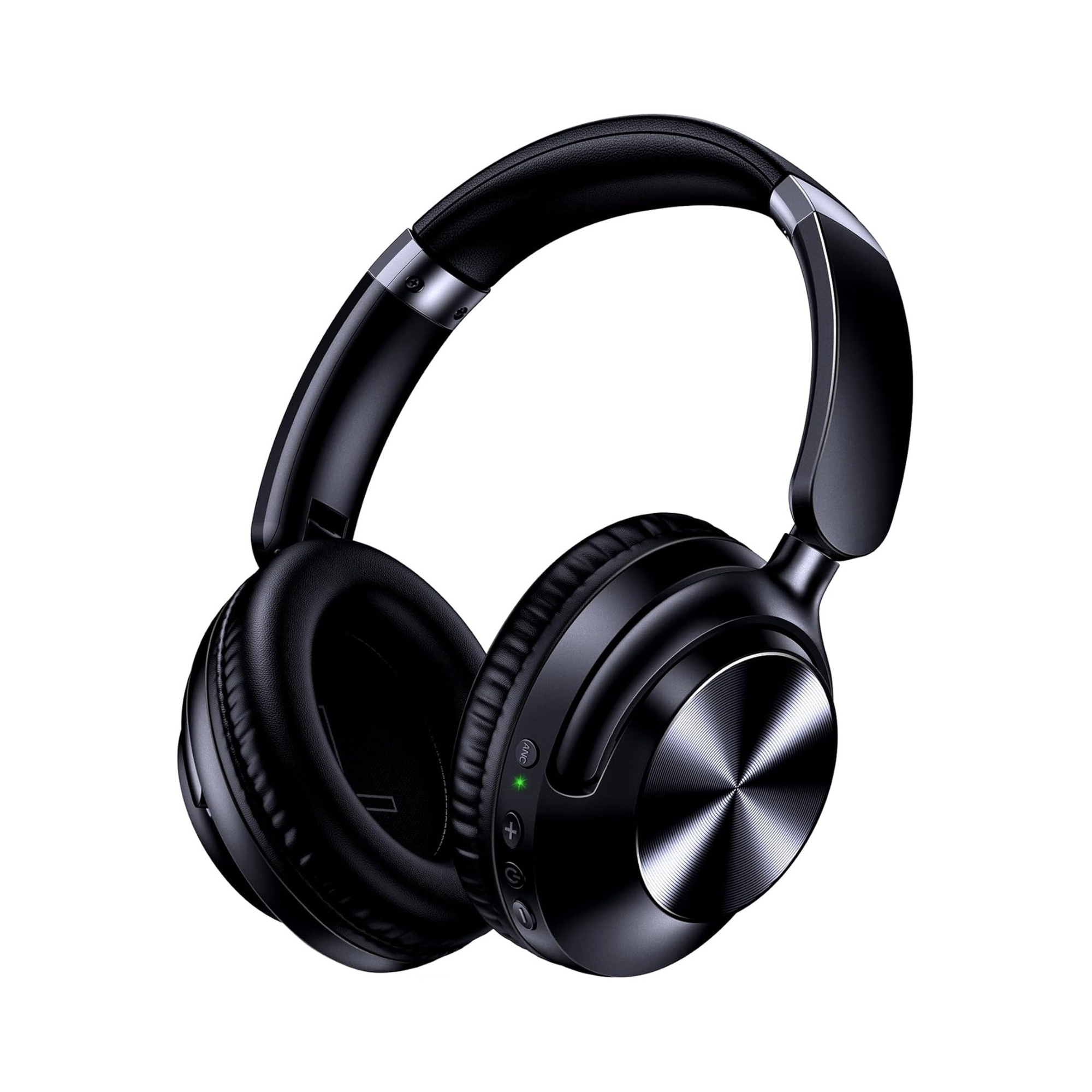
For listeners who prioritize that everyday wireless-and-wired flexibility over an open-back desktop rig, it is important to distinguish transducer and enclosure types clearly: the EARSOLE Series 127 Over-Ear Headphones (EAR-AMZ-WL-127, $44.75) is a closed-back dynamic over-ear headphone—not an open-back planar magnetic headphone. According to the EARSOLE Series 127 listing, the over-ear headphones switch between wireless Bluetooth and a 3.5 mm AUX wired connection using an included 47.2-inch audio cable. In addition, the EARSOLE Series 127 listing states Active Noise Cancellation, ultra-soft protein leather ear cups that rotate up to 105 degrees, an adjustable headband, and a travel pouch for carrying the headset. That closed-back dual-mode design lets you walk around the house on Bluetooth or plug the 47.2-inch 3.5mm cable into a home stereo, laptop, or airplane entertainment system without leaking sound to people nearby.
Frequently Asked Questions
What is the main advantage of open-back planar magnetic headphones over dynamic headphones?
According to Audeze and Headphones.com, the main advantage is how the diaphragm is driven and how the rear enclosure vents sound: planar magnetic drivers distribute electromagnetic driving force uniformly across a large, ultra-thin membrane so it moves in nearly pistonic fashion with a flat planar wavefront, low distortion, fast transient response, and deep bass extension—avoiding the center-driven cone breakup modes and inductive impedance swings of conventional dynamic drivers—while the open-back grille prevents internal cup reflections to create a wider, more natural soundstage in quiet rooms.
Do open-back planar magnetic headphones require a headphone amplifier?
Because planar magnetic conductors are printed directly onto the flat diaphragm, Audeze explains that they present a purely resistive load with a flat impedance curve across all frequencies, which helps them behave predictably across different amplifiers. However, many open-back planar magnetic headphones have lower sensitivity or higher current demands than portable dynamic headsets—Headphones.com specifically notes that models like the HIFIMAN Sundara may require a dedicated amplifier to reach proper headroom and dynamic control. You can learn more about matching impedance and sensitivity in our guide on when headphones need an amplifier.
Why are most open-back planar magnetic headphones wired instead of Bluetooth?
As highlighted in r/HeadphoneAdvice (thread 1doy83n), popular open-back planar magnetic headphones such as the HIFIMAN Sundara and Moondrop Venus are wired-only because open-back planar transducers are designed for stationary, quiet desk listening with external amplification, whereas packing large batteries, DACs, and amps into an open-back frame adds weight and still leaks sound when walking around. Listeners who want cordless freedom away from their desk alongside wired plug-in convenience typically choose closed-back headphones—either closed-back wireless planars mentioned by community members or closed-back dual-mode dynamic headphones like the EARSOLE Series 127, which switches between wireless Bluetooth and a 47.2-inch 3.5mm AUX audio cable.
