
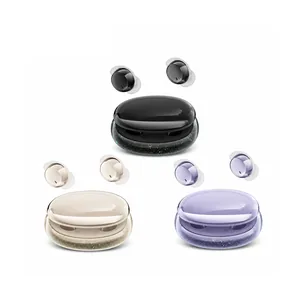


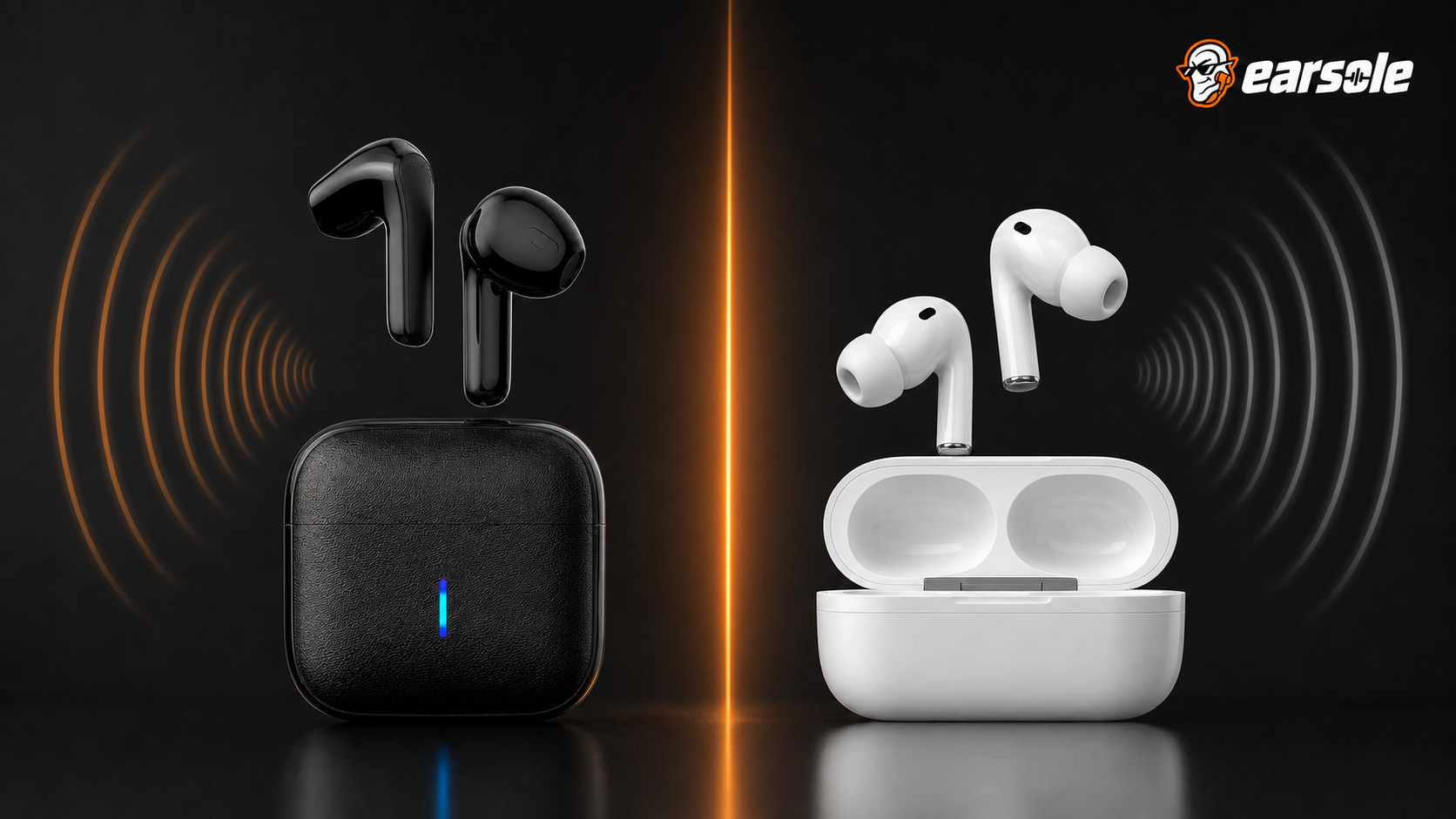
Semi in ear earbuds rest at the entrance of the ear canal on a hard, tipless nozzle, while in-ear models push a silicone or foam tip into the canal to form a seal. That single structural difference drives everything downstream: how much room sound you keep, how much bass survives, how much pressure you feel after an hour, and how much you have to turn the volume up outdoors.
Half in-ear, semi-in-ear, in-ear: three names, two shapes
Half in-ear is the same thing as semi-in-ear, and both names describe a bud whose nozzle stops at the canal entrance instead of sealing inside it. The shell rests in the concha, the bowl of your outer ear, and holds itself there by shape alone. Nothing expands, nothing seals, and there is no tip to size.
In-ear, sometimes written as in-ear monitor, means the opposite: a compliant tip couples the driver to the canal wall and closes the gap. Look at the photograph at the top of this page and the distinction is visible in one glance. The pair on the left ends in a bare rounded nozzle; the pair on the right carries a soft tip that is meant to disappear inside the canal.
The third label people meet, open-ear, is a different family again: the driver sits fully outside the canal, on a clip or a hook. Semi-in-ear sits between the two, which is exactly why the name causes so much confusion.
Where earbuds end and in-ear headphones begin
The older word earbud originally described the tipless kind, the hard plastic shape that sat in the concha, and in-ear headphones described the sealed kind. Retail language has since collapsed the two, so today earbud usually just means a small wireless pair of either shape. If you are comparing listings, the reliable signal is not the word in the title but whether the box contains ear tips in more than one size. Tips in the box means a seal is intended; no tips means the shell geometry is doing all the work.
| Question | Points to semi-in-ear | Points to sealed in-ear |
|---|---|---|
| Do tips make your ears ache? | Nothing enters the canal, so canal pressure stays low | Only if a correctly sized tip is comfortable for you |
| Is your listening room noisy? | You want to keep hearing traffic, trains and colleagues | You want passive isolation before any electronics |
| Do you care about consistent bass? | You accept bass that changes with ear shape and placement | You want the repeatable low end a seal gives |
| Do you talk a lot while wearing them? | Less occlusion, so your own voice sounds normal | Isolation on calls matters more than the boom of your voice |
| Do you move vigorously? | Your concha holds the shell without help | A tip, or a tip and wing, anchors the bud |
| Do you wear them lying down? | Only if the shell does not protrude into the pillow | Only with a genuinely low-profile sealed shape |
A worked example: the noisy commute
The seal question becomes concrete the moment there is background noise. The World Health Organization's safe-listening guidance sets out the trade: "you can safely listen to a sound level of 80dB for up to 40 hours a week", but "if the sound level is 90dB, the safe listening time reduces to four hours per week". Ten decibels of extra volume costs you nine tenths of your weekly allowance.
Now put that on a train. If a semi-in-ear pair leaves enough carriage noise in your ears that you push the volume from a comfortable indoor level up by roughly that much for a 45-minute journey each way, five days a week, you have spent a large share of the week's budget on commuting alone. This is why WHO also advises listeners to "use well-fitted, and noise cancelling headphones to reduce the need to raise volume in noisy situations". A shape that wins at a quiet desk can be the wrong tool for a loud platform, and the honest test is not which sounds better in the shop but which one you stop turning up.
If a product causes pain, irritation, ringing or a noticeable hearing change, stop using it and seek qualified care.
A seal only helps when it fits
For sealed models, the payoff is conditional on tip size. Apple's ear-tip guidance is direct about what a correct fit buys you: "when the fit is right, you experience better noise cancellation, and music has a rich bass sound." It also gives the two failure modes: "if the ear tip feels too large in your ear or is uncomfortable, try a smaller ear tip", and if you cannot get a good seal, adjust the bud or move up a size. A sealed bud with the wrong tip gives you the pressure of an in-ear design and the bass of a leaky one. Our guide to choosing an ear-tip size covers that in detail.
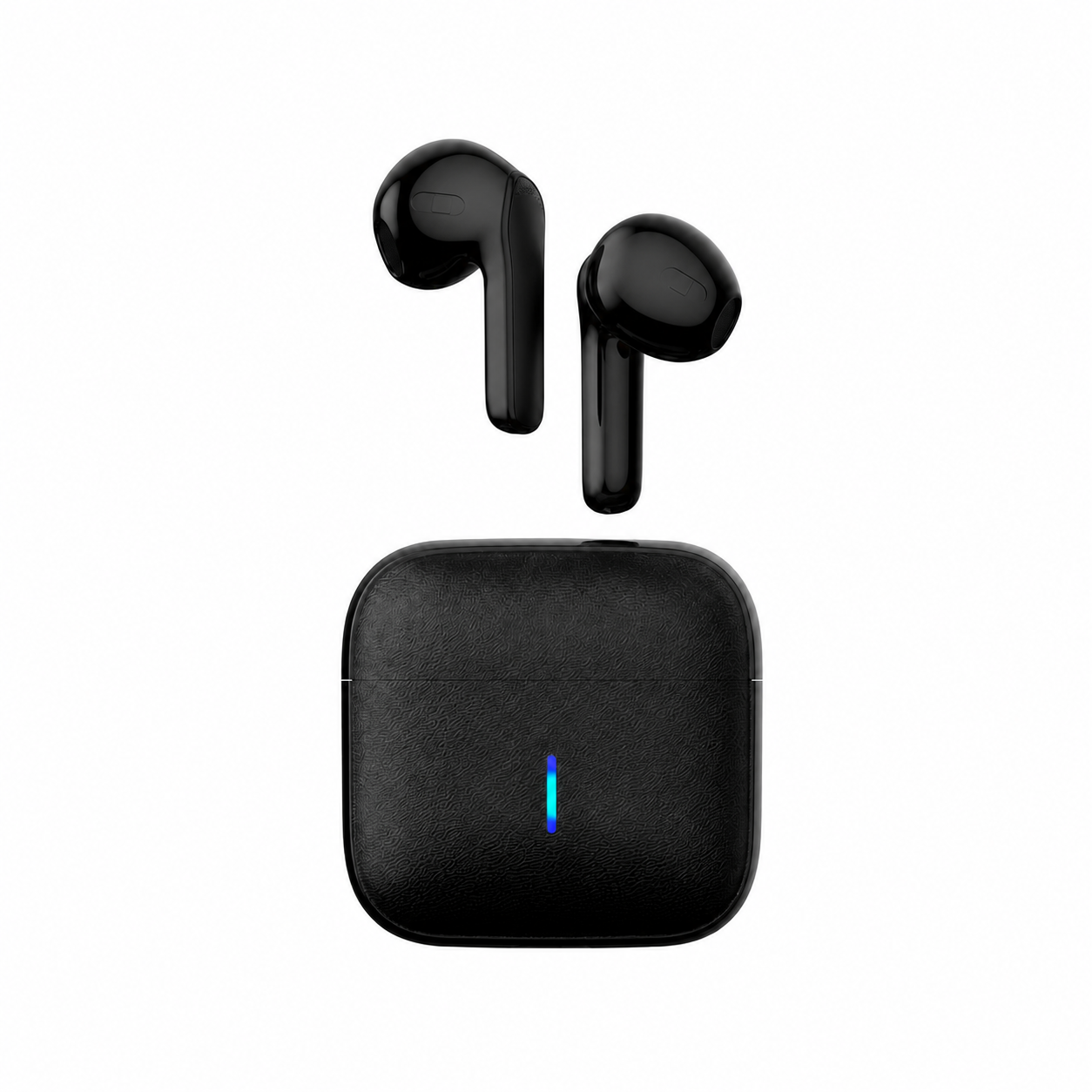
Semi-in-ear removes tip sizing from the equation and replaces it with shell-shape dependence, which you cannot swap in the box. Our EARSOLE Wireless Earbuds, Semi-In-Ear Bluetooth Earbuds with Charging Case listing describes a lightweight semi-in-ear fit with a compact charging case and a built-in microphone, at $23.99 at the time of writing; it claims no active noise cancellation and no water-resistance rating. That combination suits someone who dislikes a canal seal and listens mostly indoors. Sealed and semi-sealed alternatives sit alongside it in the everyday wireless earbuds collection.
Fit questions readers send us
Are half in-ear and open-ear earbuds the same thing?
No. A half in-ear bud still points a nozzle into the canal entrance and directs sound down it. An open-ear design keeps the driver outside the canal entirely, on a clip or hook, and leaves the ear fully unobstructed. Half in-ear gives you a little more low end than open-ear; open-ear gives you more awareness of the room.
Why does bass sound thin on semi-in-ear earbuds?
Low frequencies leak out of any gap between the bud and the canal wall, and a tipless shape leaves that gap by design. How much bass survives then depends on your particular ear shape and on exactly where the shell settles, which is why two people can disagree completely about the same pair.
Which shape is better for calls?
Fit category alone does not decide it. Microphone placement, wind, room noise, the processing on the earbud and the phone's own routing all matter more. What the shape does change is how you sound to yourself: a sealed bud makes your own voice boom, which pushes some people to speak too quietly.
Which one, then
Take semi-in-ear if canal pressure is what makes you take earbuds out, and if most of your listening happens somewhere quiet. Take sealed in-ear if you commute, want repeatable bass, or plan to use cancellation, and be willing to try more than one tip size to get there. Comfort is the ceiling on both: a shape you remove after an hour is the wrong shape, whatever it does for the sound.
