

Wind Noise Cancelling Earbuds: Why Feedforward Microphones Clip in Gusts
Active noise cancellation cuts steady transit drone, yet direct outdoor gusts often turn quiet listening into a loud, rushing rumble. When runners and commuters evaluate wind noise cancelling earbuds, they frequently notice that switching ANC on makes wind roaring significantly louder. This happens because external feedforward microphones react differently to airborne sound waves than to physical air turbulence.
The Aerodynamics of Microphone Turbulence and Feedforward Clipping
Hybrid active noise cancellation relies on external feedforward microphones positioned on the outer housing to capture incoming sound waves before they reach the ear canal. An internal digital signal processor (DSP) analyzes these acoustic waves and generates an inverted anti-phase waveform to cancel them.
Moving air, however, does not behave like acoustic pressure waves. When wind strikes an exposed microphone port, it generates localized vortex shedding and non-acoustic pressure fluctuations across the diaphragm. The microphone cannot distinguish between an airborne acoustic wave and physical turbulence.
Because turbulent gusts produce intense low-frequency pressure spikes, the microphone pre-amplifier saturates rapidly, forcing the analog-to-digital converter to clip. When the DSP attempts to generate extreme anti-phase signals to counteract this phantom pressure, it drives distorted roaring noise straight into your ear canal speaker driver.
Mechanical vs Algorithmic Wind Mitigation in Modern Earbuds
Solving wind buffeting requires two distinct engineering approaches: mechanical airflow management and algorithmic wind detection.
| Mitigation Layer | Design Mechanism | Primary Advantage | Trade-Off |
|---|---|---|---|
| Mechanical Mesh | Sintered metal or micro-mesh grilles | Diffuses laminar wind into micro-eddies before reaching diaphragm | Slightly increases housing thickness |
| Recessed Port Geometry | Angled cavity placing ports away from oncoming air vector | Minimizes direct perpendicular pressure strikes | Limits spatial microphone separation |
| Algorithmic Wind Cutoff | DSP reduces gain on external feedforward mics upon turbulence detection | Prevents speaker driver clipping and anti-phase roar | Reduces ANC attenuation for other ambient noises |
While algorithms can temporarily attenuate saturated microphones, physical wind screens remain essential. Without acoustic mesh disruption, digital algorithms must disable noise cancellation entirely to stop clipping. For athletic listening in demanding conditions, pairing acoustic mesh protection with moisture resistance is critical, as detailed in our guide on sweat-proof earphones.
EARSOLE Smart Pro 3 Architecture in Outdoor Environments
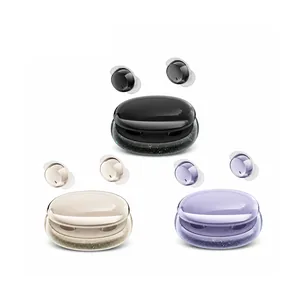
When engineering outdoor audio equipment, microphone port placement dictates real-world stability. Translation earbuds with ANC, spatial audio, and reference-only heart-rate and blood-oxygen readings in a clear-lid case. See the Smart Pro 3 details.
By pairing recessed port chambers with adaptive hybrid noise cancellation, Smart Pro 3 mitigates sudden air pressure spikes. In gusty environments, the system manages feedforward sensitivity while maintaining core isolation through its sealed in-ear acoustic nozzle.
Practical Settings and Fit Optimization for Windy Commutes
To minimize wind interference on daily commutes or training sessions, apply these practical adjustments:
- Optimize Mechanical Seal: Choose ear tips that achieve an airtight acoustic seal. Deep canal seating maximizes passive attenuation, reducing reliance on aggressive feedforward gain.
- Switch to Wind Suppression or Transparency: If your earbuds feature dedicated wind modes, activate them to let the DSP scale back feedforward sensitivity.
- Shield Housing with Headwear: Light headbands or cycling caps positioned over the upper housing deflect direct gusts away from external microphone ports without impeding audio quality.
Frequently Asked Questions
What are some good earbuds for reducing wind noise?
Effective earbuds for reducing wind noise feature recessed microphone ports, fine acoustic mesh grilles, and adaptive DSP algorithms that throttle feedforward gain during high-velocity gusts. Combining physical aerodynamic shielding with a snug passive seal provides the cleanest outdoor listening experience.
Why does wind sound louder when I turn ANC on?
Wind sounds louder with ANC enabled because incoming gusts produce rapid pressure shifts directly on the external feedforward microphone diaphragm. The ANC processor misinterprets this air turbulence as external noise and amplifies anti-phase corrections, creating an audible rushing roar.