

If you are trying to answer "do open ear earbuds leak sound" by reading the product page, that route will not work — not because the pages hide it, but because none of them uses the word. We searched every open-ear and clip-on product description in our catalogue for "leak" and its neighbours and found nothing. What two of those pages do describe, in detail, is the same physical fact from the other side: with no seal, the room comes in. This article reads that description backwards.
The word "leak" is not on any of our open-ear pages
This is the first thing to know, because it changes where you look. Across every open-ear and clip-on product description we sell, the terms "leak", "leakage", "privacy", "private", "hear you", "nearby", "others can hear" and "bleed" each appear zero times. Not once, on any page. So a shopper scanning for a leakage figure or a privacy claim will come away with nothing — and will be tempted to conclude the pages are silent on the subject. They are not silent. They are answering the mirror-image question — though only two of them answer it at all. The rest of our open-ear pages do not describe the seal in either direction, so what follows rests on those two.
The short yes-or-no is already on this site. Our open-ear versus in-ear guide answers it in its FAQ — "they can… because there is no seal, someone nearby may hear audio when the volume is high or the room is quiet" — and that guide is where to go for the whole decision of whether an open design suits you. This article is narrower and starts one step earlier: it is about why the product pages will not give you that answer, what they say instead, and how to read what they say so the inference is yours rather than a claim you have to take on trust.
What the pages do say: the ear canal stays open
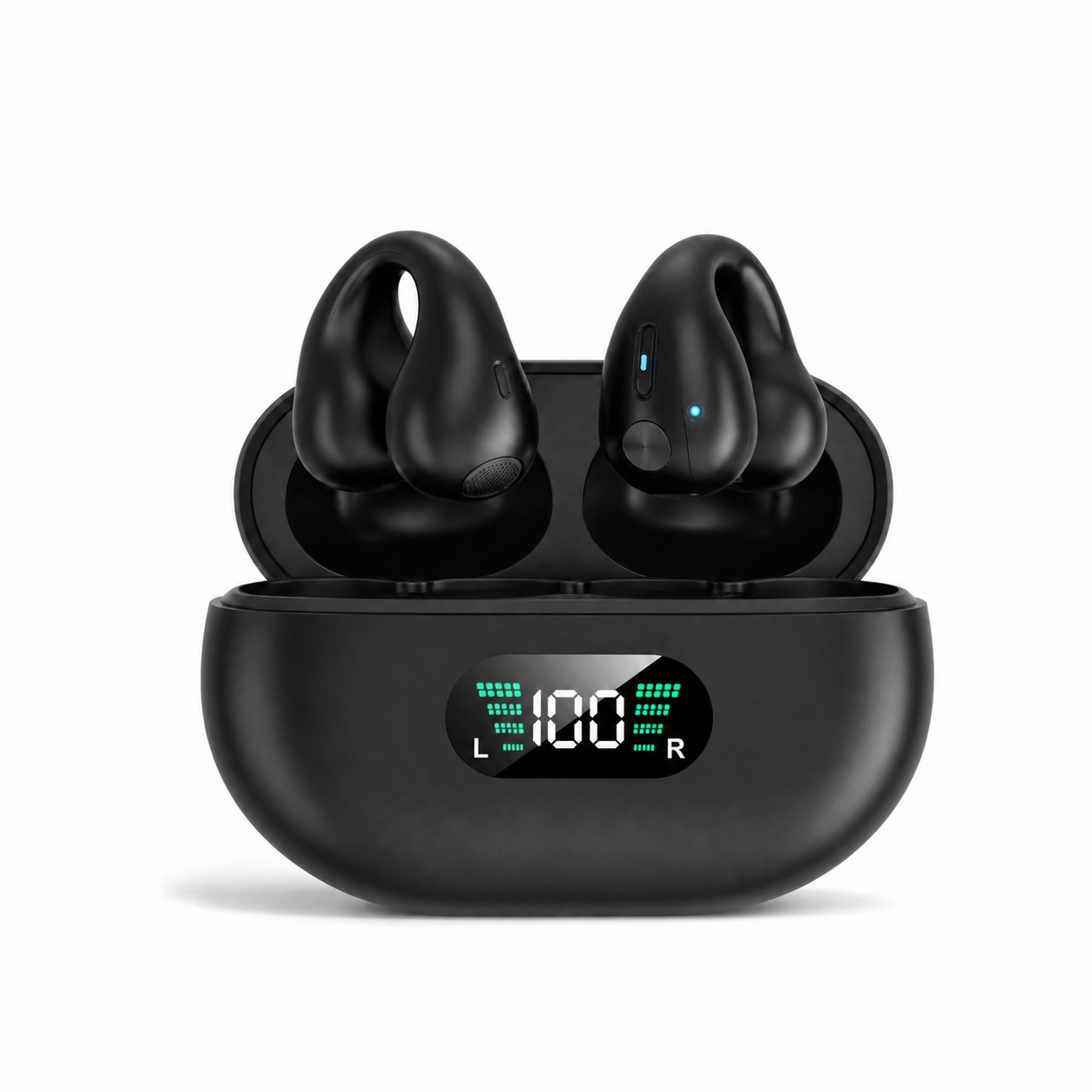
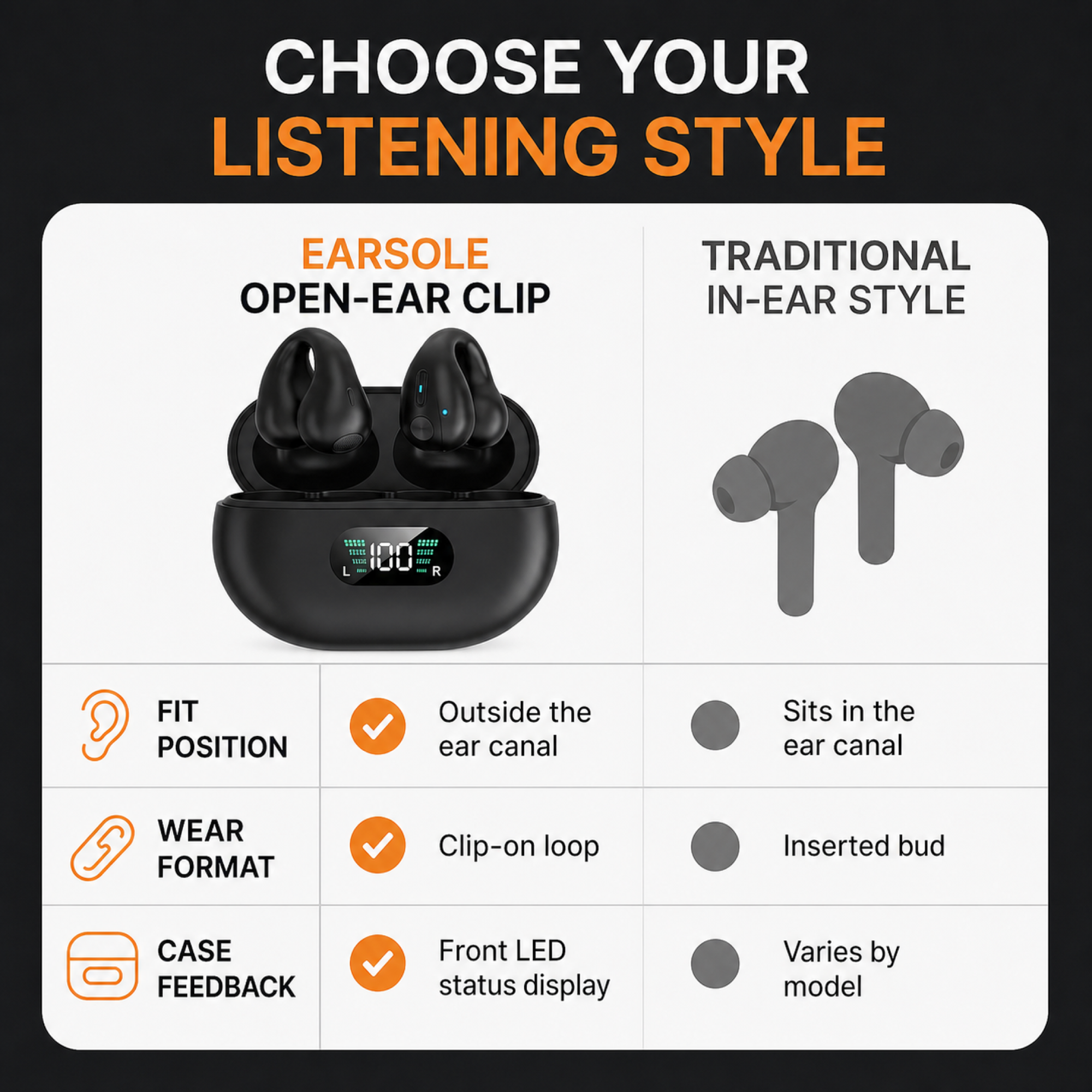
The EARSOLE Open-Ear Clip-On Wireless Earbuds with LED Charging Case page is direct about the structure. The earbuds "rest outside the ear canal instead of sealing it shut." The page frames that as the point: this style is for people who "want to stay aware of traffic, announcements and coworkers while you listen," and it adds the limit in the same breath — "because the ear canal stays open, this style is not the right pick when maximum noise isolation is your priority."
Its FAQ goes further, under the question of who these are a poor match for: "Listeners who prioritize thumping bass or need isolation in loud environments. Without a seal, low frequencies feel lighter and background noise mixes with your audio." And then: "They shine for offices, home listening, walks and errands, where hearing your surroundings is a benefit rather than a compromise." Every one of those sentences is about sound travelling inward, toward you. The page even presents the absence of a tip as a comfort point — "because there is no in-ear tip, there is none of the plugged-up pressure that makes some people give up on regular earbuds after an hour" — and that missing tip is the same absence that removes the seal.
No passive seal, so you will hear the room
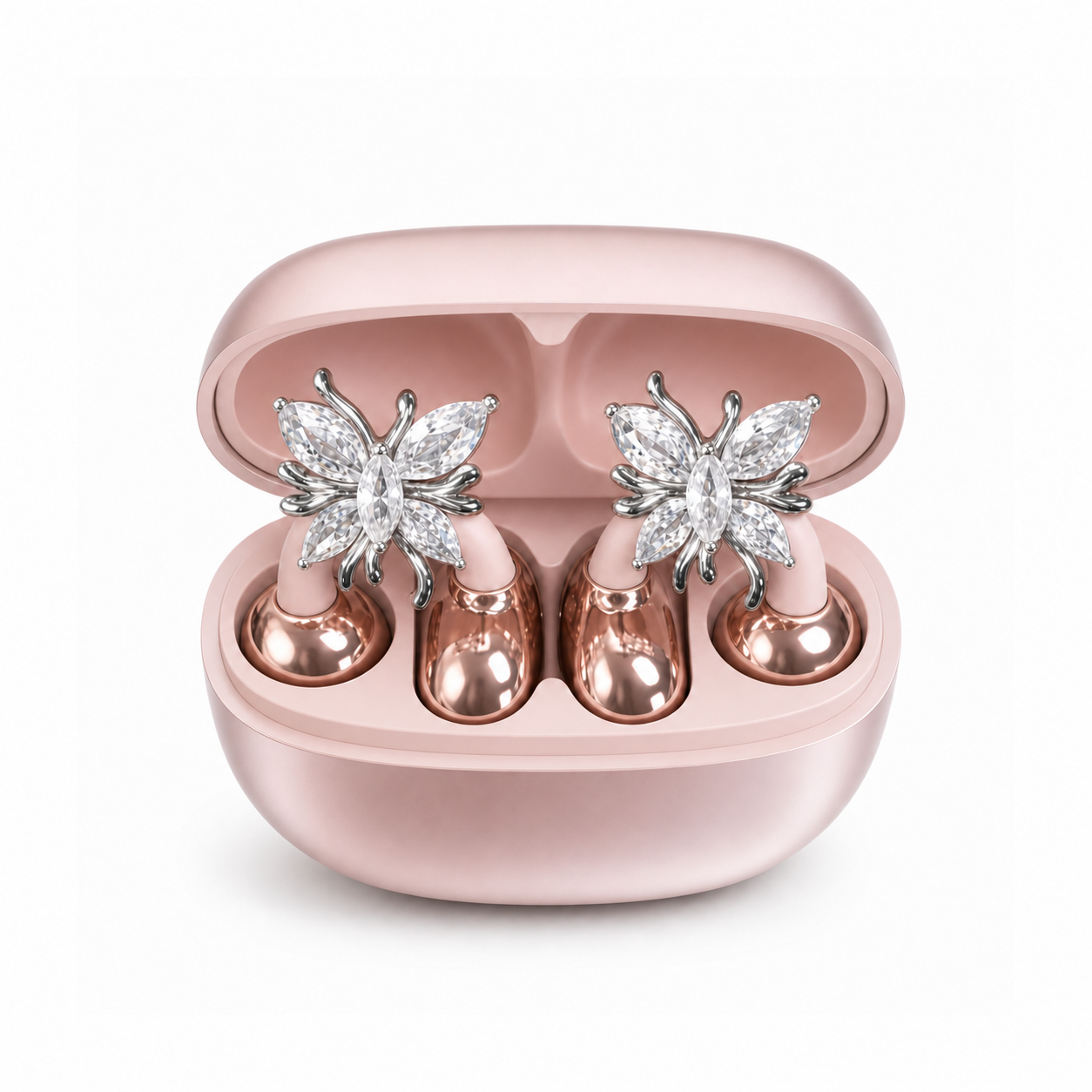
The EARSOLE Butterfly Open-Ear Clip-On Wireless Earbuds page says the same thing with one more useful word. "The open-ear design leaves your ear canal completely free, so there is no active noise cancellation and no passive seal. You will hear the room along with your audio, which is ideal for offices and commutes but not for drowning out a loud gym or flight."
"No passive seal" is the phrase to hold on to. A seal is what an in-ear tip creates when it closes the canal, and it is what keeps outside sound out. The Butterfly page states plainly that there is none. Again, though, the sentence that follows is about what reaches your ear — "you will hear the room" — not about what leaves it.
The same missing seal works in both directions
Here is the step the pages leave to you, and we want to be clear that it is a step, not something either page states. A seal is not a one-way valve. The opening that lets the room's sound reach your ear is the same opening through which your audio can reach the room. If the page tells you the canal is "completely free" and that you "will hear the room," it is also, without saying so, telling you that the room can hear some of what you play.
That is an inference from a structural description — the same one our open-ear guide states outright — but it stops exactly where the pages stop. Neither page says how much escapes, at what volume, or at what distance someone could make it out. We are not going to supply those numbers, because we have not measured them and the pages do not provide them. What the pages give you is the reason leakage is possible; the amount is not on the card.
Read the page backwards, then check at arm's length
So the practical reading is this. Wherever an open-ear page tells you what you will hear from outside — traffic, announcements, coworkers, the room — read it as also describing the path your own audio takes outward. The stronger the page's language about awareness, the more open the design, and the more that path is worth checking before you rely on it somewhere quiet.
The check itself is ours, not the pages': put the earbuds on at the volume you actually use, in the room where privacy matters to you, and ask someone one arm's length away what they can hear. No product page describes this test, and it produces a yes-or-no for your room rather than a number for all rooms. If the answer is more than you are comfortable with, the pages have already named the alternative — the LED clip-on page says "if you want silence on a plane or subway, a sealed in-ear design will serve you better," and that is equally the answer when the silence you want is for other people.
On whether an open design is better or worse for your hearing, this article does not go there; that is a question for a clinician, and the product pages are not a source for it.
The open-ear pairs are collected under open-ear and clip-on earbuds. If your use is mainly on the move, open-ear earbuds for commuting reads the same awareness language for the train and the street, and bone conduction for sport covers the other open design we carry, where the canal is not just unsealed but unoccupied.