



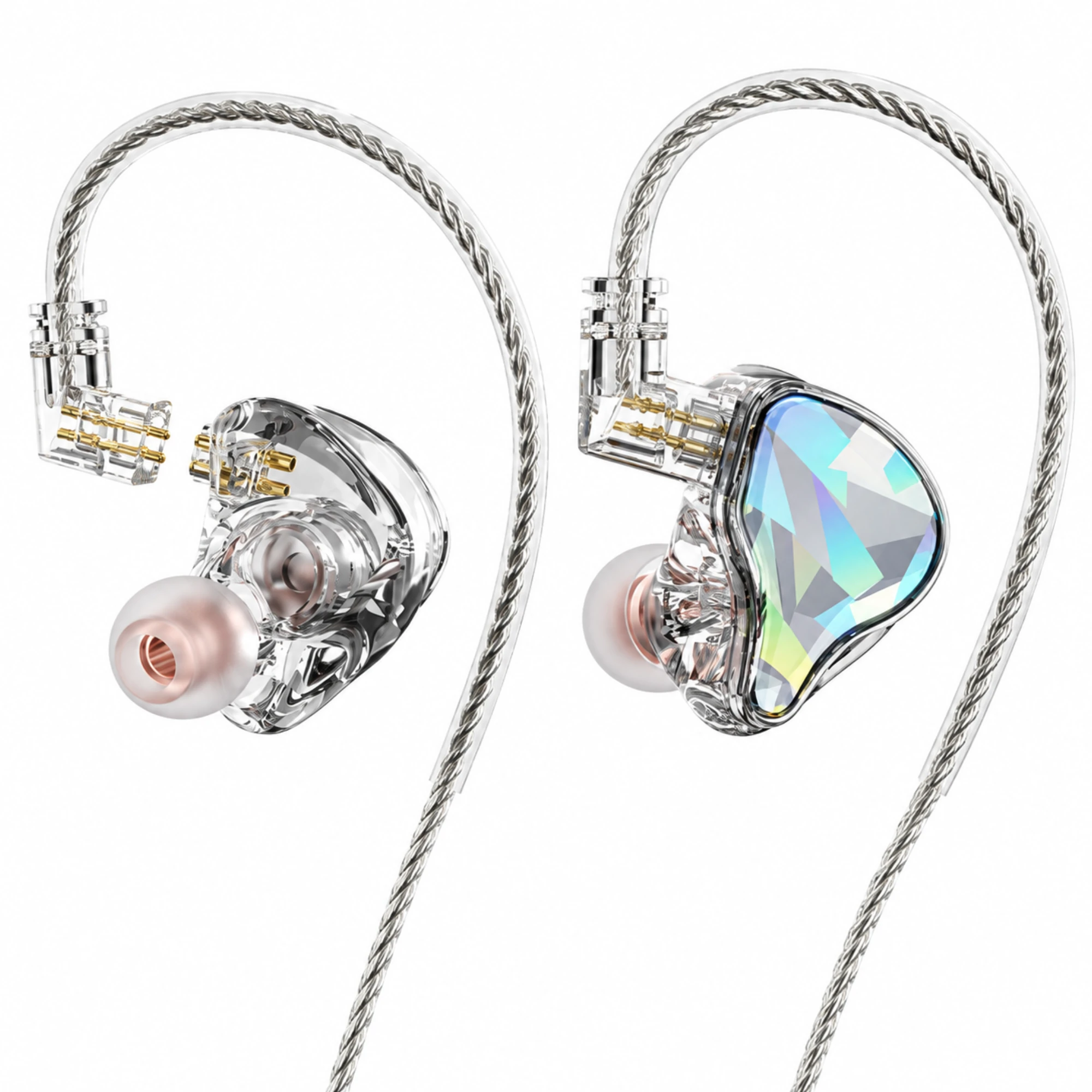
When you shop for a replacement braided aux cord, a desktop braided headphone cable, or a pair of in-ear monitors with a braided iem cable, product descriptions almost always pitch braiding as an unconditional upgrade over standard smooth-jacketed wires. Whether it is a nylon-weave sleeve over a 3.5mm car aux cord or a multi-strand twisted braid on detachable IEMs, braided cables look substantial and resist sharp desk-edge scrapes.
However, if you ask daily wired listeners how braided cords actually handle in the real world, you will hear a surprisingly sharp debate. While some users swear by braided cords for their zero-friction drape and durability, others complain that tightly wound braids develop a stubborn rotational “twist memory” that makes the wire wriggle and loop on its own. Understanding why both camps are right—and how cable geometry affects tangling—helps you choose the right cord for your headphones.
How Wired Headphone and Aux Cables Are Constructed (Wikipedia Wired Connectivity)
Every wired headphone connection must balance electrical conductivity, mechanical strain relief, and flexibility from the source jack up to your ears.
According to Wikipedia’s Headphones reference, wired headphones connect to an audio source via a cable terminated with a phone connector (typically 3.5 mm or 6.35 mm), and some headphones and in-ear monitors use a detachable cable with a socket on the earcup or earpiece housing so the cord can be unplugged or replaced.
In everyday consumer and monitoring audio, manufacturers build these cords using three distinct outer jacket structures:
- Multi-Strand Twisted / Braided IEM Cables (4-Core, 8-Core, or 16-Core): Instead of enclosing all insulated copper conductors inside one round tube, each conductor has its own clear PVC or FEP jacket, and the individual strands are woven together from the 3.5mm plug up to the Y-splitter.
- Nylon/Fabric-Sleeved Braided Aux Cords: A single round cable core wrapped in a woven textile or nylon sheath. Common on car and desktop 3.5mm AUX cords to prevent pet bites or sharp desk edges from nicking the inner insulation.
- Smooth Elastomer Jackets (TPE, Soft PVC, or Silicone): A continuous, smooth outer jacket with low torsional stiffness that bends equally in any direction without woven strand tension.
| Cable Construction | Abrasion & Pull Resistance | Rotational Twist Memory | Microphonics (Clothing Rub Noise) |
|---|---|---|---|
| Multi-Strand Braided IEM Cable (with Earhooks) | High (multi-core weave distributes pull force) | Moderate to High if tightly wound around two fingers | Low when routed over the top of the ear |
| Tight Nylon-Sheathed Braided Aux Cord | Very High (resists desk corners and car consoles) | High if the outer nylon weave is stiff | Moderate to High if it rubs against a zipper or collar |
| Smooth TPE / Silicone AUX Cable | Moderate (flexible for tight pocket storage) | Low once relaxed | Low to Moderate |
Why Some Listeners Love Braided Cables While Others Hate Their Twist Memory (r/iems Debate)
Why does the same category of braided headphone cable inspire both loyalty and frustration? The answer comes down to weave tension, insulation durometer (softness), and how the cable is coiled when stored.
When a multi-core braid or stiff nylon sheath is woven under high tension, twisting the cable in one direction tightens the helix while twisting it the opposite way loosens it. If you wrap that cable around your hand in a tight circle—adding a 360-degree axial twist with every loop—the braided geometry stores that rotational energy like a spring and tries to snap back to a specific angle.
In r/iems (thread 1s4y9wo, “I hate braided cables.”), a listener vents frustration with stiff multi-strand braids: “I hate them. They always have this tendency to orient themselves. Always have to use them in this specific angle at this specific amount of twist or else they will wriggle and twist, tangling with anything it comes into contact. I much prefer silicon or just canvas sleeve. Soft, easy to store, doesn’t twist and orient as easily.”
Yet in the same r/iems thread (1s4y9wo), another commenter points out that not all braided cords behave the same way: “I’ve got 3 different braided cables and have never had any issues with tangling.”
How to Prevent a Braided Aux Cord or IEM Cable From Self-Twisting
- Use the Over-Under Coiling Method: Never wind a braided aux cord or braided iem cable tightly around four fingers like a ball of yarn. Alternating a normal loop (“over”) with a reverse-twist loop (“under”) cancels out net axial torsion so the braid lies completely flat when uncoiled.
- Let the Earpieces Spin Free Before Plugging In: With detachable IEM cables, holding the 3.5mm plug in one hand and letting the Y-split hang vertically for two seconds allows any accumulated twist from your carrying case to unwind naturally before you hook the monitors over your ears.
- Keep Over-Ear Hooks Properly Seated: On monitoring earphones, pre-formed heat-shrink earhooks anchor the top of the cable over your pinna so the lower braided section hangs straight down without tugging at the nozzle.
Comparing Detachable Braided Over-Ear IEM Cables vs Smooth 3.5mm AUX Cords
In the EARSOLE catalog, you can see how both cable philosophies—a detachable multi-strand braided cable for in-ear monitors and a smooth detachable 3.5mm AUX cord for over-ear headphones—serve their respective form factors:
- Detachable Braided 2-Pin Cable on In-Ear Monitors: According to the EARSOLE product catalog, the EARSOLE Faceted In-Ear Monitors with Detachable Braided Cable ($11.96) pair clear resin ergonomic shells and geometric gold-accented faceplates with a detachable 2-pin braided silver-toned cable featuring pre-formed over-ear hooks and a 3.5mm gold-plated stereo plug (with acoustic impedance and driver measurements noted as unverified in the listing). Here, the braided multi-strand construction keeps the cable supple below the Y-split while the detachable 2-pin sockets let you unplug or swap the cord if it ever snags on a studio desk.
- Smooth 3.5mm AUX Backup Cable on Dual-Mode Over-Ear Headphones: According to the EARSOLE product catalog, the EARSOLE Noise Cancelling Over-Ear Headphones, Wireless & Wired – Series 127 ($29.40) include a smooth 47.2-inch (1.2 m) detachable 3.5mm AUX audio cable alongside Bluetooth 5.4 wireless connectivity and up to 100 hours of battery life. For full-size over-ear headphones that fold into a travel pouch, a smooth 3.5mm AUX jacket slides effortlessly across clothing without the fabric-on-fabric friction noise (“microphonics”) that stiff nylon-sheathed aux cords can transmit into an earcup.
If your existing wired headset or aux cord already has stubborn kinks from tight pocket wrapping, follow our step-by-step tutorial on how to straighten twisted headphone wires.
Frequently Asked Questions
Why do some braided headphone or aux cords twist and coil on their own?
Multi-strand braided cables have a directional weave. When you wrap them tightly around your hand in one direction, each loop adds rotational twist that fights against the braid’s natural pitch—causing the cable to orient itself at specific angles or wriggle into loops, as discussed in r/iems (thread 1s4y9wo).
Are braided cables always more tangle-free than smooth rubber or silicone cords?
Not automatically. A loosely woven multi-core braid with soft insulation resists tangling very well (which is why many r/iems users report zero tangling across multiple braided cables), whereas a stiff, high-tension braid can hold coil memory more stubbornly than a soft silicone or smooth elastomer jacket.
When does a detachable braided cable make sense on in-ear monitors?
A detachable 2-pin braided cable with pre-formed over-ear hooks—like the cord on the EARSOLE Faceted In-Ear Monitors—makes sense when you want low-friction drape down your chest, over-the-ear weight relief that stops cable tug from breaking your ear-tip seal, and the ability to replace the wire independently of the earpieces.
