When a swimmer pushes off the pool wall and submerges their head, standard wireless earbuds fail for two separate reasons: water breaks the acoustic seal inside the ear canal, and pool water absorbs the 2.4 GHz Bluetooth radio signal coming from a phone on deck. Understanding how do swimming headphones work comes down to how purpose-built swim headsets solve both problems at once—by moving the acoustic contact point outside the ear canal onto a wraparound rear-band frame, and by switching from live Bluetooth streaming to local onboard MP3 memory stored inside the headset itself.
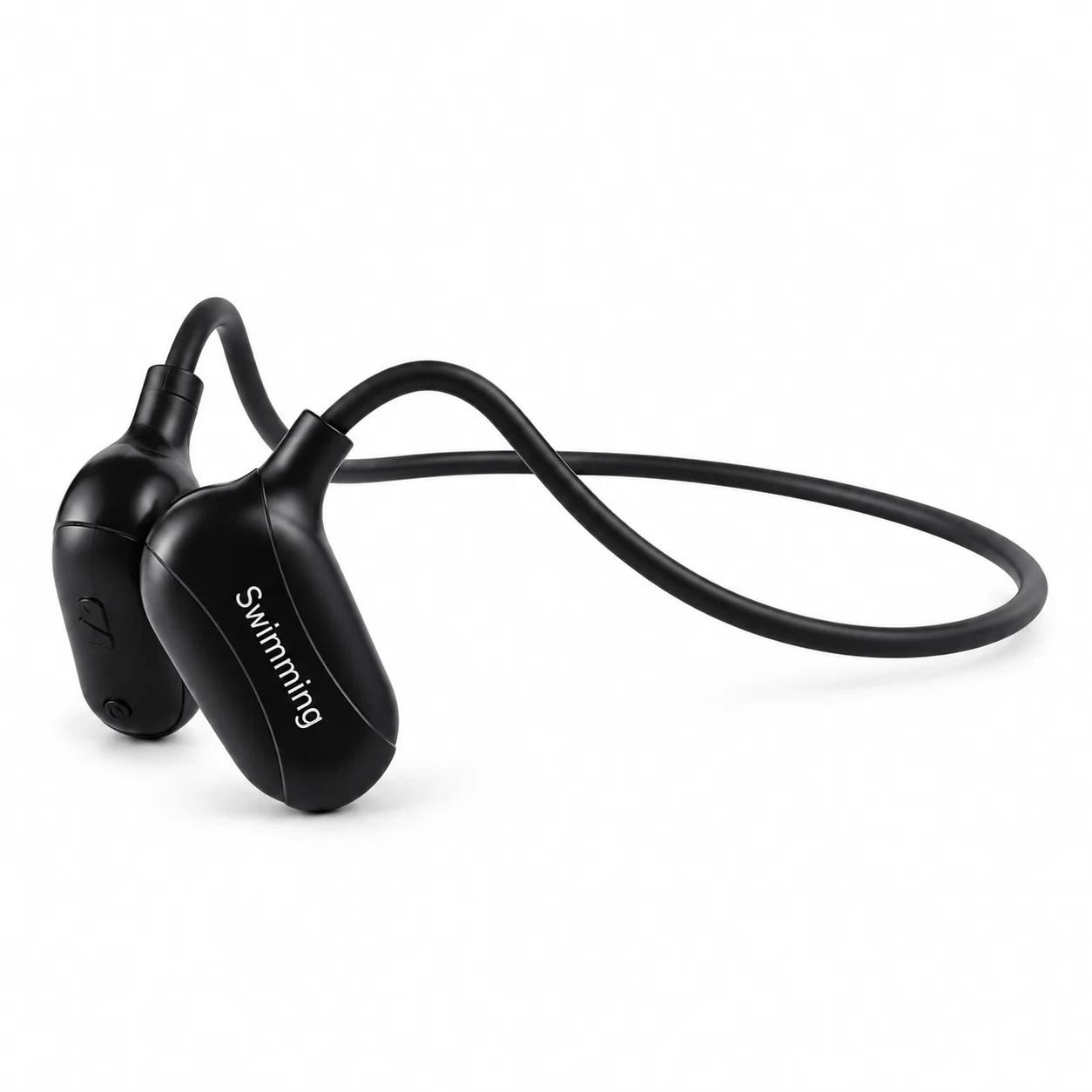
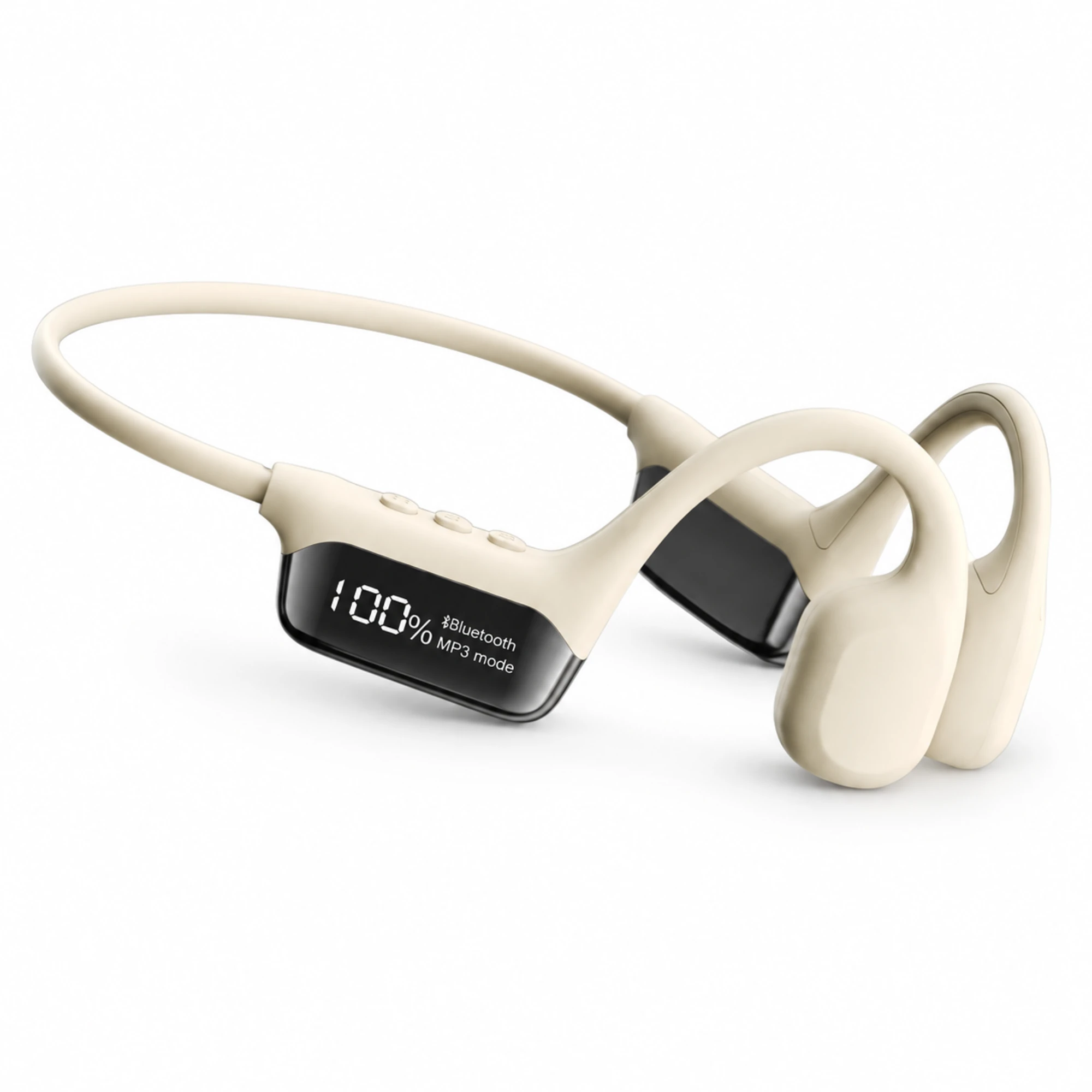
In the Earsole Swimming Headphones catalog, two rear-band designs illustrate the hardware choices shoppers encounter in this category: the $69.99 S10 Swimming Headphones with MP3 Mode, which uses a cream wraparound frame where ear hooks join cheek-contact pads, an MP3 mode, and a digital side display, and the $55.00 Rear-Band Wireless Headphones - Black, 16GB Version, which pairs black elongated side housings and external controls with a catalog-listed 16GB configuration. Examining the acoustic coupling, the 2.4 GHz water boundary, and the exact catalog verification limits of both headsets shows what happens to sound once your ears dip below the surface.
1. Acoustic Coupling: How Cheek-Contact Pads and Side Housings Deliver Sound Without Plugging the Ear
Conventional air-conduction earbuds rely on a tiny speaker pushing air waves down a dry, sealed ear canal to vibrate the eardrum. As soon as water enters the gap between a silicone ear tip and the canal wall, that air column vanishes, leaving the audio muffled or uneven between strokes.
Open-ear and rear-band swimming headphones take a different mechanical path. Instead of inserting a nozzle into the ear canal, a flexible rear band wraps behind the head and holds either flat cheek-contact pads or elongated side housings against the cheekbones and sideburn area just in front of the ears. In dedicated bone conduction swimming headphones, mechanical vibrations travel through the cheekbone directly to the inner ear without requiring an airborne path through the ear canal.
Real-world lap swimmers in Reddit’s r/Swimming community highlight three practical effects of this outer-ear geometry in the water:
- Submerged water coupling during freestyle vs breaststroke: Swimmers in
r/Swimmingreport that cheek-positioned swimming headphones often sound clearer underwater than in open air because the surrounding water helps conduct vibrations across the cheekbone contact area—making freestyle laps (where at least one side of the head remains submerged during rotation) more consistent than breaststroke (where both ears repeatedly rise above and drop below the surface). - Swim-cap pressure on the sideburns: Because cheek-contact pads and side housings depend on steady skin contact in front of the ear, a tight silicone swim cap pulled directly over the frame arms can lever the pads slightly away from the cheekbones. Positioning the cap edge so the pads rest flat against the cheekbone preserves contact during push-offs and flip turns. (For dryland fit with helmets and eyewear, see our guide on wearing bone conduction headphones for running, cycling and the gym.)
- Managing water swish with or without earplugs: Leaving the ear canal open allows swimmers to hear lane-mates and poolside whistles when paused at the wall, though some swimmers in
r/Swimmingnote that water swishing in an unsealed ear canal can compete with spoken-word podcasts unless paired with swim earplugs, whereas rhythmic music remains easy to follow.
2. Signal Physics: Why 2.4 GHz Bluetooth Fails in Water and Why MP3 Mode Takes Over
The second question almost every buyer asks—“Can you use Bluetooth headphones while swimming?”—has a strict physics answer. All standard Bluetooth audio devices transmit on the 2.4 GHz radio frequency. Water molecules rapidly absorb and attenuate 2.4 GHz radio waves within a few centimetres of submersion. Even if your phone is resting on a kickboard or the pool deck two metres away, the wireless link drops as soon as the headset antenna goes underwater.
That radio-frequency barrier is why waterproof swimming headphones and mp3 sport headphones separate dryland listening from pool playback:
- Bluetooth Mode (Dryland & Pool Deck): Used out of the water for warmup routines, gym sessions, or locker-room streaming from a smartphone.
- Local MP3 Mode (In-Pool Submersion): As swimmers in
r/OpenWaterSwimmingexplain, swimming headsets require preloading audio files directly onto onboard flash memory before entering the water. Because the audio file is decoded and played locally inside the headphone housing, no radio signal has to travel through the water during your laps.
3. Comparing Two Earsole Rear-Band Swimming Headphone Architectures
When comparing rear-band models in the Earsole catalog, shoppers are choosing between two distinct physical interfaces and storage disclosures: a cream wraparound cheek-pad frame with a built-in status screen versus a screenless black rear-band frame with a stated 16GB storage configuration.
| Feature / Specification | S10 Swimming Headphones with MP3 Mode | Rear-Band Wireless Headphones - Black, 16GB Version |
|---|---|---|
| Catalog Price | $69.99 | $55.00 |
| Frame & Contact Geometry | Cream wraparound design where ear hooks join oval cheek-contact pads and the rear band | Black rear-band frame with elongated side housings resting along the temple/ear line |
| On-Body Controls & Display | Top physical buttons plus a glossy black digital side display showing battery percentage and Bluetooth / MP3 mode | External physical controls along the side housing; no digital display screen |
| Playback & Storage Listing | Listed with an onboard MP3 mode (exact gigabyte capacity not stated in catalog) | Catalog-listed 16GB configuration for local audio storage |
| Catalog Verification Boundaries | Independent waterproof IP depth ratings, internal storage capacity in GB, and battery runtime hours are not published | Water resistance, underwater operation, and any preloaded audio content have not been independently verified |
S10 Swimming Headphones with MP3 Mode ($69.99)
According to the Earsole catalog listing, the S10 Swimming Headphones with MP3 Mode ($69.99) features a cream wraparound design, an MP3 mode, and a digital side display, where the ear hooks join the cheek-contact pads and rear band. Visually, the side module integrates a compact digital readout that confirms whether the headset is set to Bluetooth or MP3 mode along with battery percentage—solving a common annoyance on multi-mode headsets where swimmers have to guess which playback mode is active before pushing off the wall.
Verification boundary to keep in mind: While the S10 is cataloged in the Swimming Headphones collection with an explicit MP3 mode and cheek-contact pads, the Earsole catalog record does not publish independent waterproof IP immersion depth ratings, internal storage capacity in gigabytes, or verified bone-conduction transducer specifications.
Rear-Band Wireless Headphones - Black, 16GB Version ($55.00)
For shoppers who prioritize a stated storage capacity figure at a lower price point, the Rear-Band Wireless Headphones - Black, 16GB Version – Swimming Headphones ($55.00) uses a matte black rear-band frame with elongated side housings and external physical controls in the catalog-listed 16GB configuration. Rather than putting a digital screen on the temple, it relies on tactile buttons along the housing edge.
Verification boundary to keep in mind: The Earsole catalog listing explicitly states that for this 16GB configuration, water resistance, underwater operation, and any preloaded audio content have not been independently verified. Shoppers who require certified multi-metre immersion depth testing should note this disclosure before using the headset for submerged pool training.
4. Practical Checklist Before Taking MP3 Swimming Headphones to the Pool
- Load DRM-Free Audio Files Before Leaving Home: Streaming apps cannot beam 2.4 GHz Bluetooth audio through pool water. Transfer local audio files onto the headset’s onboard storage over USB and test playback in MP3 mode on dry land first.
- Switch from Bluetooth to MP3 Mode on Deck: On the S10 Swimming Headphones with MP3 Mode, verify that the digital side display reads MP3 mode before pulling on your goggles.
- Seat the Cheek-Contact Pads or Side Housings Ahead of the Cap Edge: Make sure the ear hooks sit cleanly over the ears so the cheek-contact pads (on the S10) or elongated side housings (on the Black 16GB model) rest flat against the cheekbone without being pried outward by a tight swim cap.
- Match the Hardware to Verified Exposure Limits: Because neither the S10 catalog listing nor the Black 16GB catalog listing includes independent third-party waterproof depth certification, treat unverified water-resistance boundaries conservatively and rinse salt or chlorinated splashes with fresh water on a soft cloth rather than submerging unverified ports under pressure.
Frequently Asked Questions
How do swimming headphones work underwater without blocking your ear canal?
Open-ear and rear-band swimming headphones use a wraparound rear band and ear hooks to hold cheek-contact pads or elongated side housings against the cheekbones and sideburns outside the ear canal. Swimmers in Reddit’s r/Swimming community report that water helps conduct vibrations to the cheekbones when at least one side is submerged during freestyle, while keeping the ear canal open unless the swimmer chooses to wear earplugs to reduce water swish. In Earsole’s catalog, the $69.99 S10 Swimming Headphones with MP3 Mode uses cheek-contact pads and a digital side display, whereas the $55.00 Rear-Band Wireless Headphones - Black, 16GB Version uses elongated side housings and external controls; neither listing independently verifies underwater immersion depth or bone-conduction certification.
Can you use Bluetooth headphones while swimming, or why do you need MP3 mode?
Standard Bluetooth headphones operate on the 2.4 GHz radio frequency, which water molecules absorb and attenuate within centimetres of submersion. As a result, a phone left on the pool deck cannot maintain a stable Bluetooth stream once your head goes underwater, so swimmers switch to onboard MP3 mode and play audio files preloaded directly onto the headset. In Earsole’s catalog, the S10 Swimming Headphones with MP3 Mode ($69.99) provides an onboard MP3 mode with a digital side display (storage size in GB not stated), while the Rear-Band Wireless Headphones - Black, 16GB Version ($55.00) provides a catalog-listed 16GB configuration with unverified water resistance and underwater operation.