



When you search for singing with in ear monitors or ask why do singers wear earbuds, the biggest misconception is treating the earpieces as a self-contained vocal monitor. On their own, wired in-ear monitor earpieces are passive isolating earphones. They only let you hear your own voice in real time when they are plugged into an upstream monitoring chain such as a stage mixer aux send, an audio interface with direct monitoring, or a wireless belt-pack receiver.
Before buying a pair of earpieces for rehearsals or gigs, you need to separate what the earpieces handle at your ear canal from what the upstream hardware handles on stage or at home. You also need to know why plugging earpieces straight into a smartphone monitoring app often introduces a noticeable vocal delay, and which physical specs to check on a product page such as the EARSOLE In-Ear Monitors collection.
What In-Ear Monitors Do for a Singer on Stage
According to Wikipedia’s in-ear monitor article, an in-ear monitor is used by musicians, audio engineers, and audiophiles to hear a personal mix of vocals and stage instrumentation for live performance or recording studio mixing, often specifically in order to hear themselves through a sound system in real time.
According to Wikipedia’s in-ear monitor article, traditional floor wedges placed on stage directed toward performers can greatly increase the onstage volume, in some cases to levels that could potentially damage hearing.
In Reddit’s r/singing thread on in-ear monitors, the original poster reported that their bandmates said it was a night and day difference, partially because they were not trying to compete with the band for volume and could focus and sing at whatever volume they needed while letting the sound person adjust their levels.
In that same r/singing thread, commenter fuzzynyanko wrote that they cannot tell how loud they are without any sort of monitoring, while commenter swimNotsink noted that hearing yourself is very important with a band, though stage monitors are feasible as well if the instruments are not too loud.
In that same r/singing thread, commenter mezzolini offered a contrasting view, remarking that classical singers are trained to sing by feel rather than by sound.
What Has to Sit Upstream of the Earpieces (Stage Packs vs Phone Practice)
Because the earpieces only play the electrical signal sent down their cable, the monitoring experience depends on the hardware feeding them. The table below compares a stage wireless monitor rig, a wired home practice interface, and a smartphone monitoring app.
| Setup Type | Upstream Hardware Required | Vocal Monitoring Behavior | Best Use Case |
|---|---|---|---|
| Wireless stage rig | Mixer monitor send + offstage RF transmitter + belt-pack receiver | Real-time personal mix delivered to a 3.5 mm jack on the belt pack | Live band performances where performers move across the stage |
| Wired mixer or audio interface | Vocal microphone + mixer or USB audio interface with direct monitor out | Real-time hardware monitoring over a wired headphone cable | Stationary rehearsal rooms, seated performers, and home vocal tracking |
| Smartphone app setup | Phone microphone input + digital app processing + headphone output | Signal undergoes analog-to-digital-to-analog conversion, which can add delay | Casual karaoke or pitch checks when dedicated hardware is unavailable |
According to Wikipedia’s in-ear monitor article, most professional stage in-ear monitor systems use wireless technology consisting of a stationary offstage transmitter and an onstage receiver about the size of a deck of cards worn by the performer, where the IEM cable plugs into a 3.5 mm stereo jack on the receiver pack.
In an r/singing thread asking about using an in-ear monitor with a phone to practice, commenter HelviusCinna reported that the two phone apps they tested both had some latency because phone apps turn the input signal into a digital representation and convert it back to an analog output, which takes a bit of time compared with dedicated hardware.
In that same r/singing phone-practice thread, commenter orbweaver82 reported using the Smule karaoke app on an iPhone with the headphones that come with the iPhone and said its in-ear monitoring worked quite well for them.
Why Ear Canal Seal and Over-Ear Cables Matter (and What to Check on EARSOLE’s Listing)
Once you have a mixer, audio interface, or belt pack feeding your vocal mix, the earpieces themselves determine how well outside stage sound is blocked and how securely the cables stay in place. For a broader look at how monitor earpieces differ from everyday consumer earphones, see our guide on in-ear monitors vs earbuds.
According to Wikipedia’s in-ear monitor article, the in-ear monitors themselves are the last stage of the signal path in the system and are placed in the external ear canal to seal against its sides, where a poor seal increases ambient noise leakage and universal IEMs typically include a variety of foam and silicone tips in each pack.
According to Wikipedia’s in-ear monitor article, wire-over-ear routing is preferred for professional use, providing a more discreet and secure fit with reduced microphonics, while wire-down designs can be easier to put in with one hand and avoid extra pressure behind the ears with glasses.
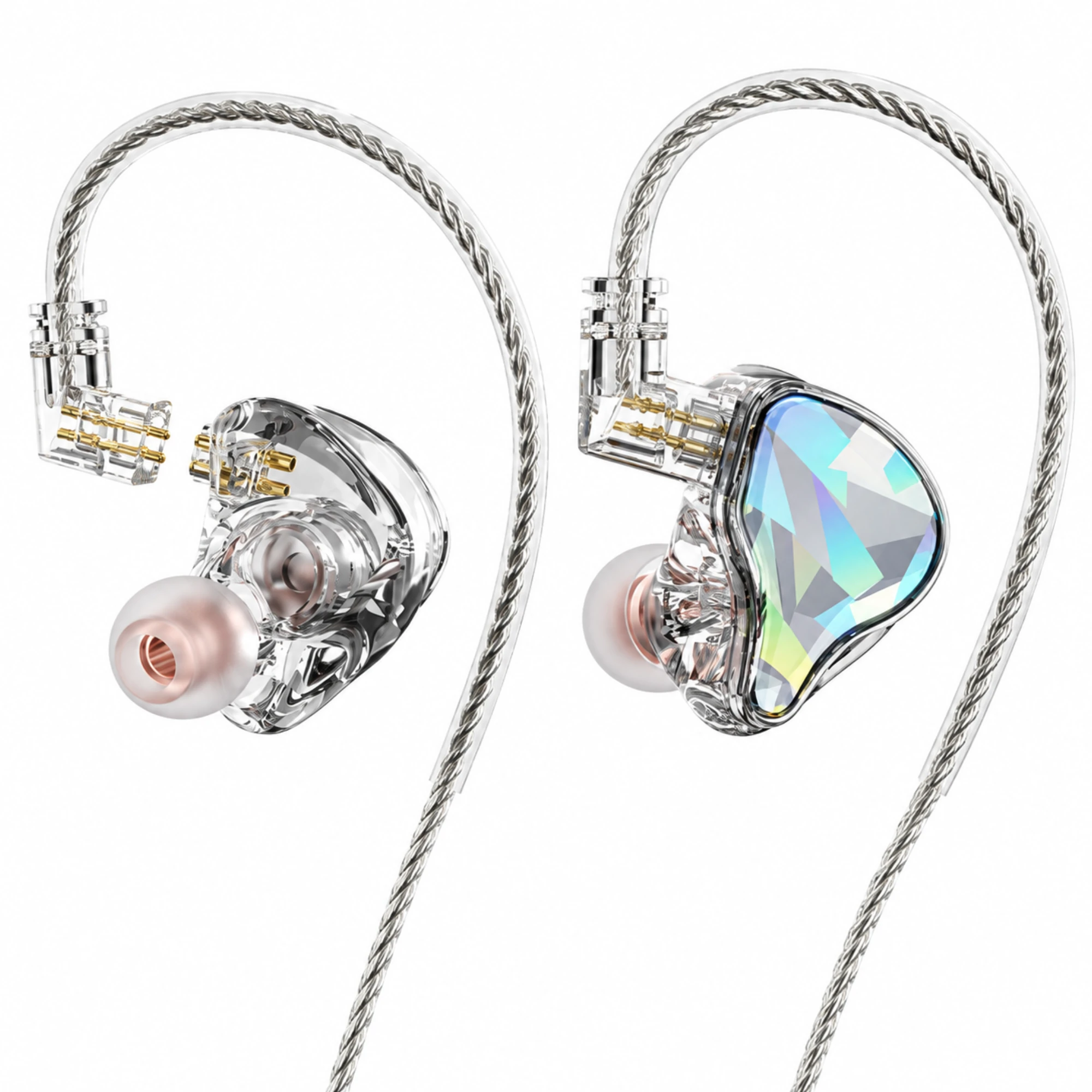
On the EARSOLE Faceted In-Ear Monitors with Detachable Braided Cable product page, the listing describes clear in-ear shells, reflective faceted faceplates, and a braided over-ear cable listed by the supplier as wired earphones for monitoring.
The EARSOLE Faceted In-Ear Monitors product page also notes that the display image shows a detachable two-pin connection, while connector size, acoustic measurements, and device compatibility have not been verified.
Checklist Before Buying In-Ear Monitors for Singing
- Confirm your upstream mix source first: Verify whether your venue, rehearsal space, or home desk provides a mixer aux output, a wireless belt-pack receiver, or a direct-monitoring audio interface before buying earpieces.
- Check the plug and adapter requirements: Stage belt packs typically take a 3.5 mm stereo plug, whereas many home mixers and audio interfaces use a 6.35 mm headphone jack or require a separate adapter.
- Test multiple ear tip sizes for a full seal: Because ambient noise leaks in whenever the ear canal seal breaks, try every included silicone or foam tip size while moving your jaw as you do when singing.
- Read product spec disclosures carefully: When looking at the EARSOLE Faceted In-Ear Monitors with Detachable Braided Cable, keep in mind that the listing provides wired over-ear earpieces with a detachable two-pin cable, not a wireless transmitter pack, and leaves plug size and acoustic measurements unverified.
Why do singers wear earbuds on stage?
According to Wikipedia’s in-ear monitor article, musicians use in-ear monitors to hear a personal mix of vocals and stage instrumentation in real time, and wireless stage systems connect the earpiece cable to a 3.5 mm stereo jack on an onstage receiver pack fed by an offstage transmitter.
Can I use in-ear monitors with my phone to practice singing?
In Reddit’s r/singing thread on phone monitoring, commenter HelviusCinna reported that two phone apps they tested both had some latency due to analog-to-digital-to-analog conversion, whereas commenter orbweaver82 said the Smule karaoke app worked quite well for them with wired iPhone headphones.
Why do stage in-ear monitors loop the cable over the ear?
According to Wikipedia’s in-ear monitor article, wire-over-ear routing is preferred for professional use because hooking the wire onto the ears and running it behind the back provides a more discreet, secure fit with reduced cable microphonics, while a tight ear-canal seal prevents ambient noise leakage.
